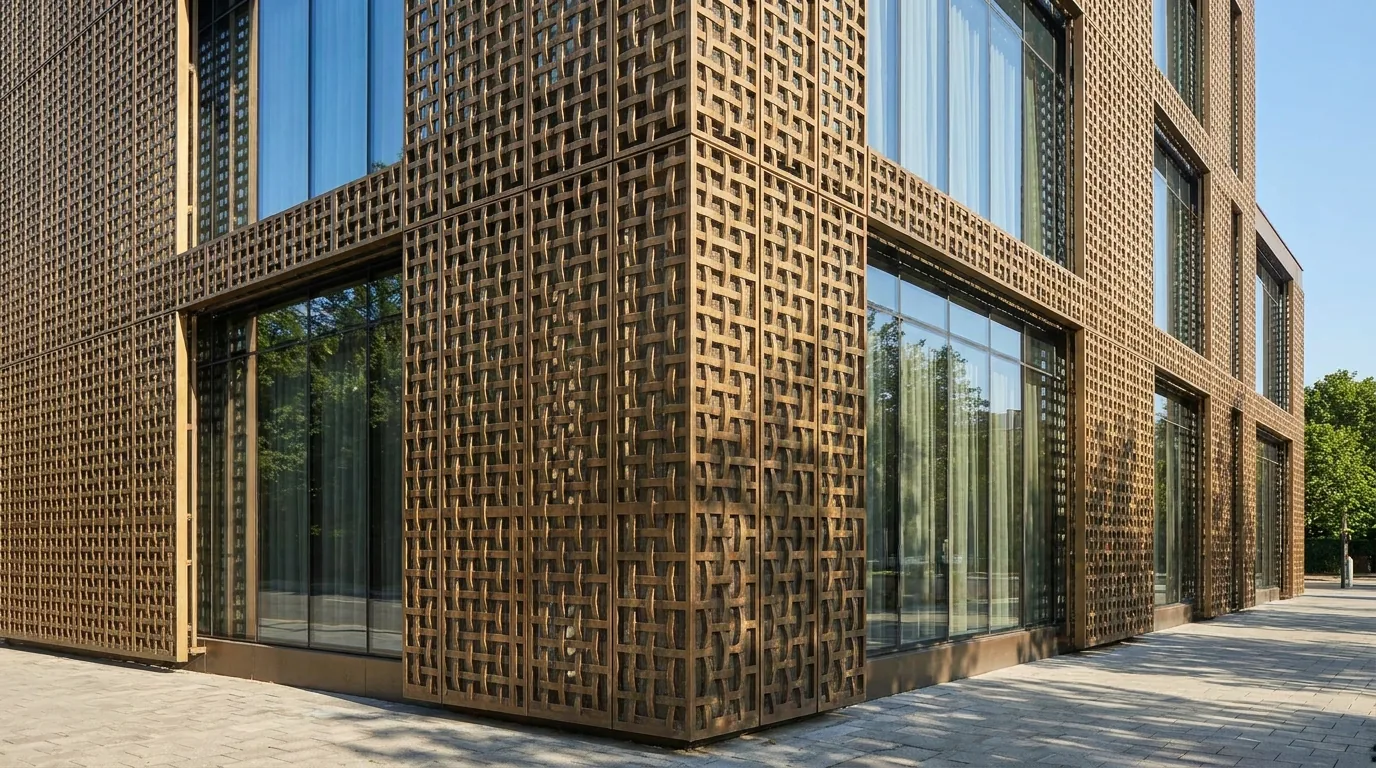
Materials / Perforated metal
Façades, screens & meshPerforated metal façades, screens and mesh
Bespoke perforated metal, expanded metal and woven mesh for façades, brise soleil, screens, partitions and feature walls. In brass, bronze, stainless and steel, brushed, patinated or in PVD colour, made to a custom pattern and finished in the atelier.
Perforated and expanded metal for architecture
Perforated metal turns a solid sheet into a screen. By punching a pattern of openings into brass, bronze, stainless or steel, a panel can filter light, soften a view, let air move and quieten a room, while still reading as one considered surface. It is the material that lets a building breathe without losing its line.
Alongside perforated sheet sit two relatives. Expanded metal is slit and stretched from a single sheet into a diamond lattice, rigid and economical with no waste. Woven and welded mesh is built from wires or rods into an open grid, from a fine fabric-like veil to a heavy architectural net. Each carries a different open area, depth and texture, and each is chosen for the job the screen has to do.
Patterns and open areas
The pattern is the design. Hole size, shape, spacing and open area decide how much light passes, how private a space stays and how the surface reads up close and from across a street. A small, dense perforation reads almost solid and shimmers; a large, open pattern becomes a graphic screen.
We work to a custom perforation, including graduated patterns where the density shifts across a panel to follow the sun, frame a view or carry an image dissolved into dots. The pattern is resolved against the structure behind it and signed off on a sample before any sheet is cut.
Woven and welded mesh
Woven metal mesh brings movement and depth that a flat perforated sheet cannot. Crossed wires or rods catch light along their length, so the surface shifts as you move past it. Stainless steel mesh is the workhorse for exterior and high-traffic positions; brass and bronze mesh bring warmth to interiors, balustrades and feature walls.
Mesh can be tensioned in a frame, hung as a drape or fixed as a rigid panel. We detail the fixing, the frame and the edge so the mesh sits taut and true, and finish it to match the rest of a metal package.
Applications
Materials and finishes
Perforated panels and mesh can be made in brass, bronze, copper, stainless steel and steel, and finished brushed, mirror, hammered or patinated. For colour that holds outdoors and under heavy use, we apply PVD coating to a stainless substrate, in any tone from the PVD colour chart, from gold and bronze to black. For the warmth and ageing of solid metal, see brass finishes and copper and bronze patina in the Journal.
For exterior and marine positions we specify stainless or a salt-tested PVD colour on stainless, so a perforated façade keeps its colour through bright light and salt air for years. Where a darker architectural skin is wanted, corten and weathering steel can be perforated too. For the woven alternative to a cut-sheet screen, read metal mesh and woven metal in the Journal.
The bespoke process
If you are asking whether we make this, the answer is yes. Dekap designs, fabricates and finishes bespoke perforated metal, expanded metal and woven mesh in-house, from a single screen to a panelised façade. We resolve the pattern, the substrate and the fixing, finish to an approved sample, and document the work for contract-grade specification. The same hands carry a panel from drawing to the crated, finished screen on its way to site. See related pieces in our work.
Perforated metal FAQ
What is perforated metal used for in architecture?
Perforated metal is used for façades, brise soleil, screens, partitions, balustrade infill and ceilings. It controls light, view, airflow and acoustics while keeping a building open and light, and it reads as a refined, crafted skin rather than a solid wall.
Perforated or expanded metal, which should I specify?
Specify perforated metal where you want a flat, rigid panel with a precise, even pattern, including custom and graduated perforation. Specify expanded metal where a stronger, deeper diamond lattice and a more industrial texture suit the scheme; it is slit and stretched from a single sheet, so it wastes no material. For a woven look, see our metal mesh guide.
Can you make a custom perforation pattern?
Yes. We work to a custom pattern, hole size, spacing and open area, including graduated and image-based perforation where the density shifts across a panel. The pattern is set against the light, view and structure the screen has to manage, and signed off on a sample before production.
Is perforated metal suitable for exterior façades?
Perforated metal is widely used on exterior façades, as rainscreen cladding, brise soleil and solar screening. Outdoors the panel must be stiff enough for wind load, fixed so it can move with heat and drained so water does not sit on the cut edges, with 316 stainless steel, plain or PVD-coloured, for coastal positions. The pattern is checked at full size in daylight before production.
Does Dekap make bespoke perforated metal and mesh?
Yes. Dekap, an architectural metal atelier in Istanbul since 2009, designs, fabricates and finishes perforated metal, expanded metal and woven mesh in-house, from façade and screen panels to partitions and ceilings, in brass, bronze, stainless steel and steel. Pattern and finish are approved on a sample panel, and backing frames, edges and fixings are engineered so each panel sits flat.
Can perforated metal panels be acoustic?
Perforated metal panels become acoustic when a sound-absorbing layer is fixed behind them, so sound passes through the holes and is absorbed while the face still reads as metal. Hole size, pitch and open area are tuned to the absorption the room needs, usually to the acoustic consultant's target, and the same approach works on walls and ceilings. The pattern is approved on a sample panel.