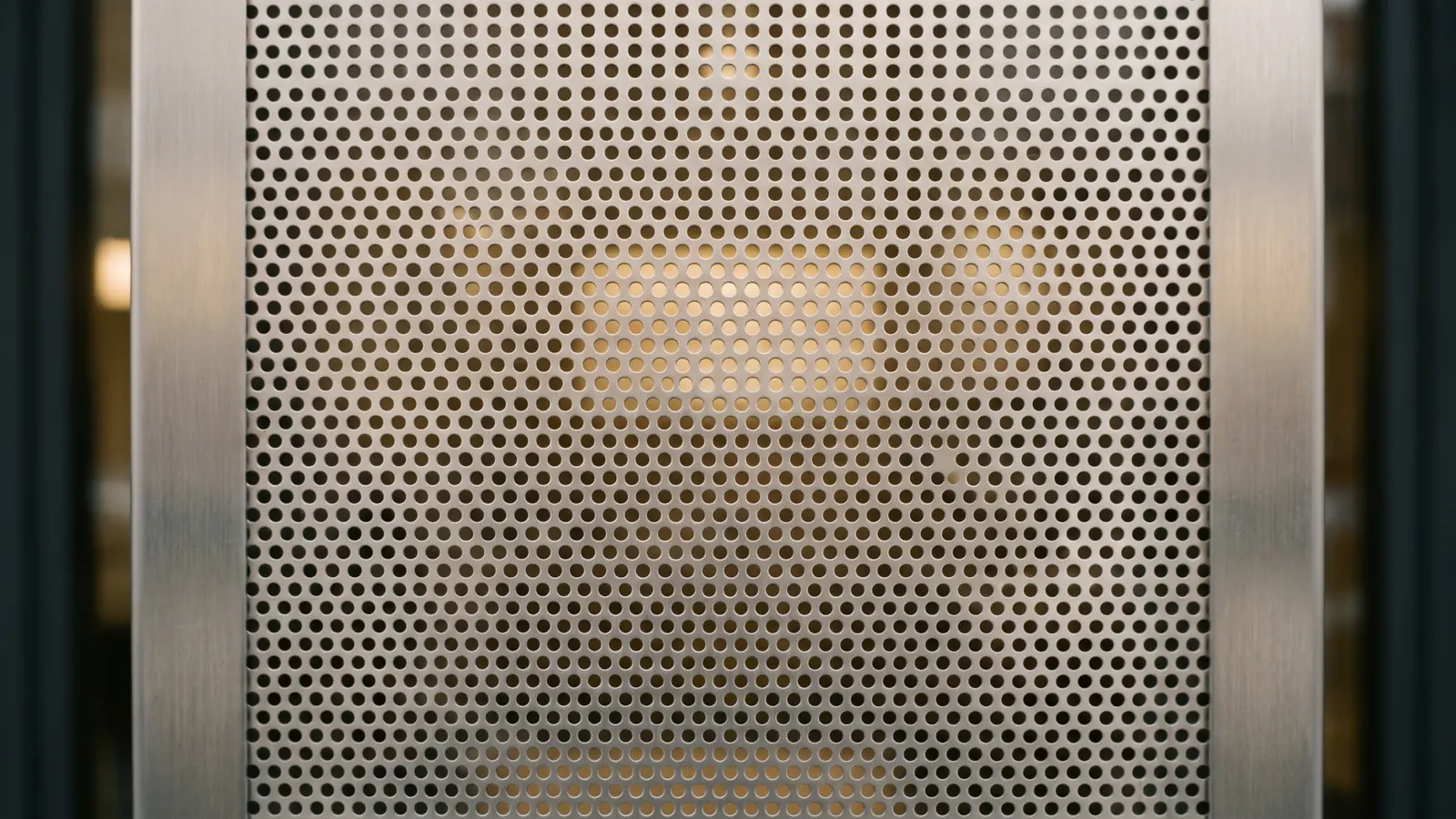
Perforated metal in architecture
Perforated metal is a solid sheet turned into a surface that breathes. A flat plate is punched with a field of holes, and what was closed becomes half open: it filters sun, passes air, softens a light source and screens a view, while still reading as a single, disciplined plane of metal. Unlike a weave or a stretched sheet, perforated metal starts flat and stays flat, which is why architects reach for it when they want the openness of a screen with the crispness of a panel. This guide sets out what architectural perforated metal is, how it differs from mesh, the pattern language behind it, and what to weigh when specifying it.
What architectural perforated metal is
Architectural perforated metal is a flat sheet or panel punched or cut with a regular field of openings and made to be seen rather than hidden. It is distinct from the perforated sheet used for grilles, filtration or industrial screening, which is chosen for a spec sheet rather than a facade. In architecture the sheet is selected for its pattern, its hole size, its openness and the way it carries light, and it is made in the metals and finishes that belong to the rest of the palette. It arrives as flat sheets or as rigid framed panels, which is the quality that sets it apart from a flexible woven surface.
How it differs from mesh
Perforated metal is often confused with metal mesh, and the two do overlap in effect, but they are made in opposite ways. Mesh is built up from separate wires, rods or cut and stretched sheet, so it is woven, welded or expanded, and much of it is flexible and needs tension to sit flat. Perforated metal is the reverse: it begins as one solid sheet and has material removed, so it stays rigid and planar by nature. That difference shows in the read. Mesh has depth and shimmer, and closes up markedly at an angle. Perforated metal reads as a clean, even field of holes, flatter and more graphic, and it holds a crisp edge and a precise line where mesh drapes. Where a scheme wants a taut, sheet-like plane rather than a woven veil, perforated metal is usually the better answer.
The pattern language
The character of a perforated panel comes from three linked decisions: the shape of the hole, its size, and the spacing between holes, which is the pitch. Round holes are the most common and the most neutral, giving an even, quiet field that suits almost any elevation. Square holes read more geometric and modern, with a harder grid. Slot perforations, short straight openings, give a directional, linear texture that can run with a facade or emphasise a horizontal line. Beyond these, a bespoke pattern can be cut to a drawing, so the field is not a catalogue standard at all but a motif particular to the project.
Hole size and pitch together set the openness. A small hole on a tight pitch reads almost like a fine screen from a distance and dissolves into tone; a large hole on a wide pitch reads boldly as a pattern of voids. The single number that governs behaviour is the open area, the proportion of the sheet that is void rather than metal. A high open area passes more light, air and view and reads more transparent; a low open area reads dense and private and closer to a solid panel. Choosing hole, pitch and open area together is really about deciding how the surface should look and behave at each distance and time of day.

Graduated and image perforation
Perforation does not have to be uniform. A graduated pattern varies the hole size or spacing across the sheet, so a panel can shift from nearly solid at one edge to nearly open at another, controlling privacy and light exactly where each is wanted. Taken further, the same technique renders an image: by varying hole size across a large elevation, a perforated facade can carry a soft picture or a texture that resolves only at a distance and dissolves back into an even field close up. It is a considered way to give a large plain surface depth and meaning without applied ornament.
Materials and finishes
Perforated sheet takes the same metals as the rest of an architectural scheme. Stainless steel is the workhorse: strong, corrosion-resistant, suited to exterior facades and wet or high-traffic interiors. Brass and bronze bring warmth and age, and are chosen where the panel should read gold or deep brown and settle over time. Aluminium is light, which matters on a large facade or a hung soffit. Finish is the next decision. Sheet can be brushed to a soft satin grain, patinated to an aged tone, powder coated to a fixed colour, or given a hard, fixed metal colour by PVD, which carries warm and dark tones across stainless in a scratch and tarnish-resistant surface. That last route is a real advantage on an exterior panel that is hard to reach for maintenance, because the colour is in the surface rather than sitting on top of it. The pattern and the finish together set the character, one soft and satin and quiet, another dark and geometric and precise.

Where it works
Perforated metal does its best work at a handful of positions. As a facade or solar screen it filters sun and screens plant, parking or a car deck while giving a large elevation a single, even material. As a feature screen or partition it divides arrival from lounge, or restaurant from bar, without closing the space in. As balustrade infill it fills a balustrade zone with a flat, safe plane that keeps a stair or gallery feeling light. In a ceiling or soffit it conceals services while passing air, light and sound, and gives a flat plane a fine, even texture. And as a light filter it sits in front of a source or a window to soften glare into a gentle wash. In each case the panel earns its place by being open and solid at the same time.

Structure and flatness
A perforated panel is only as good as its flatness, and a large punched sheet wants to move. Getting a clean, taut plane is a matter of specifying the right sheet thickness and open area for the span, and of backing or framing the panel so it stays true. Smaller panels can be folded at the edges into a shallow tray that stiffens them; larger ones are fixed to a backing frame or subframe engineered for the position and, on a facade, for wind load. The edge detail matters as much as the field, since a crisp, resolved edge is what makes a perforated panel read as considered rather than cut. On any exterior sheet the frame, the fixings and the flatness are engineering questions as much as visual ones, and they belong in the design early rather than at the end.
Light and privacy
The reason perforated metal works so well is that it does two things at once. Because each hole passes light and view but the surrounding metal blocks them, the surface reads as a soft, even filter rather than a hard barrier. From a lit interior at night it can glow, the holes picked out against the dark metal; by day it screens the inside from view while letting those within see out, since the eye reads the bright field beyond the small openings. Open area and hole size tune this balance, more open for light and view, more closed for privacy and shade, which is why the same material can serve as a sunscreen and a privacy layer in a single plane.
Working with Dekap
If you are asking whether we make this, the answer is yes. Dekap designs, makes and finishes architectural perforated metal to order, in sheet and framed panel, in any metal and any pattern a scheme needs, from standard round, square and slot fields to a bespoke pattern or a graduated, image-forming perforation cut to a drawing. This guide reflects how we make and finish perforated metal in our own workshop. We finish in-house and seal exposed surfaces, where wanted, with our own protective formula, developed in the atelier to hold colour and resist corrosion longer than a standard coat, and we agree the pattern and finish against approved sample plates before production. On one recent screen the client wanted a panel that felt private from the entrance yet let the lounge keep its view, so we tuned the hole size and open area on samples until it read both ways. Where a panel is exterior, high-touch or hard to reach, we carry a hard, fixed colour by PVD on stainless, and we engineer the backing frames, edges and fixings so the finished panel sits flat and true.
If you are specifying perforated metal for a current project, start a project enquiry, and tell us the position, the pattern you have in mind and roughly how open it should read. We will recommend the pattern, open area and finish, not just supply the sheet.
FAQ
What is architectural perforated metal?
Architectural perforated metal is a flat sheet or panel punched or cut with a regular field of openings and made to be seen, used for facades, feature screens, partitions, balustrade infill, ceilings and cladding. It differs from grille or filtration sheet in that it is chosen for its pattern, hole size, openness and the way it carries light, in metals and finishes that match the rest of a scheme.
What is the difference between perforated metal and metal mesh?
Perforated metal starts as one solid sheet and has holes removed, so it stays rigid and flat and reads as a clean, even field. Metal mesh is built up from separate wires, rods or stretched sheet, so it is woven, welded or expanded, often flexible, and has depth and shimmer that closes up at an angle. Perforated metal suits taut, sheet-like planes; mesh suits woven, veil-like ones.
What perforation patterns are possible?
The common patterns are round, square and slot, set out on a regular pitch, and beyond these a bespoke pattern can be cut to a drawing. Hole size and pitch set the openness, and a graduated pattern can vary the holes across a sheet, from nearly solid to nearly open, or even render a soft image across a large facade.
What is open area and why does it matter?
Open area is the proportion of the sheet that is void rather than metal, and it governs how the surface behaves. A high open area passes more light, air and view and reads more transparent; a low open area reads denser and more private and closer to a solid panel. It is the single number that tunes a perforated surface between a sunscreen, a privacy layer and a light filter.
Which metals and finishes can perforated metal have?
Perforated metal is most often stainless steel, for strength and corrosion resistance, and brass or bronze where warmth and an ageing finish are wanted, with aluminium used where light weight matters. Surfaces can be brushed, patinated, powder coated, or given a hard, fixed colour by PVD on stainless, which is well suited to exterior and high-touch positions because the colour is in the surface rather than on top of it.
Does Dekap make perforated metal?
Yes. We design, make and finish architectural perforated metal to order, in sheet and framed panel, in any metal and any pattern a scheme needs, from standard round, square and slot fields to a bespoke or graduated, image-forming perforation cut to a drawing. We finish in-house, seal exposed surfaces with our own protective formula where wanted, agree the pattern and finish on approved sample plates, and can carry a hard, fixed colour by PVD on stainless for exterior or high-touch positions. We also engineer the backing frames, edges and fixings so the finished panel sits flat and true.
Specifying perforated metal?
Tell us the position, the pattern you have in mind and roughly how open it should read. We will recommend the pattern, open area and finish, not just supply the sheet.
Start a project enquiry