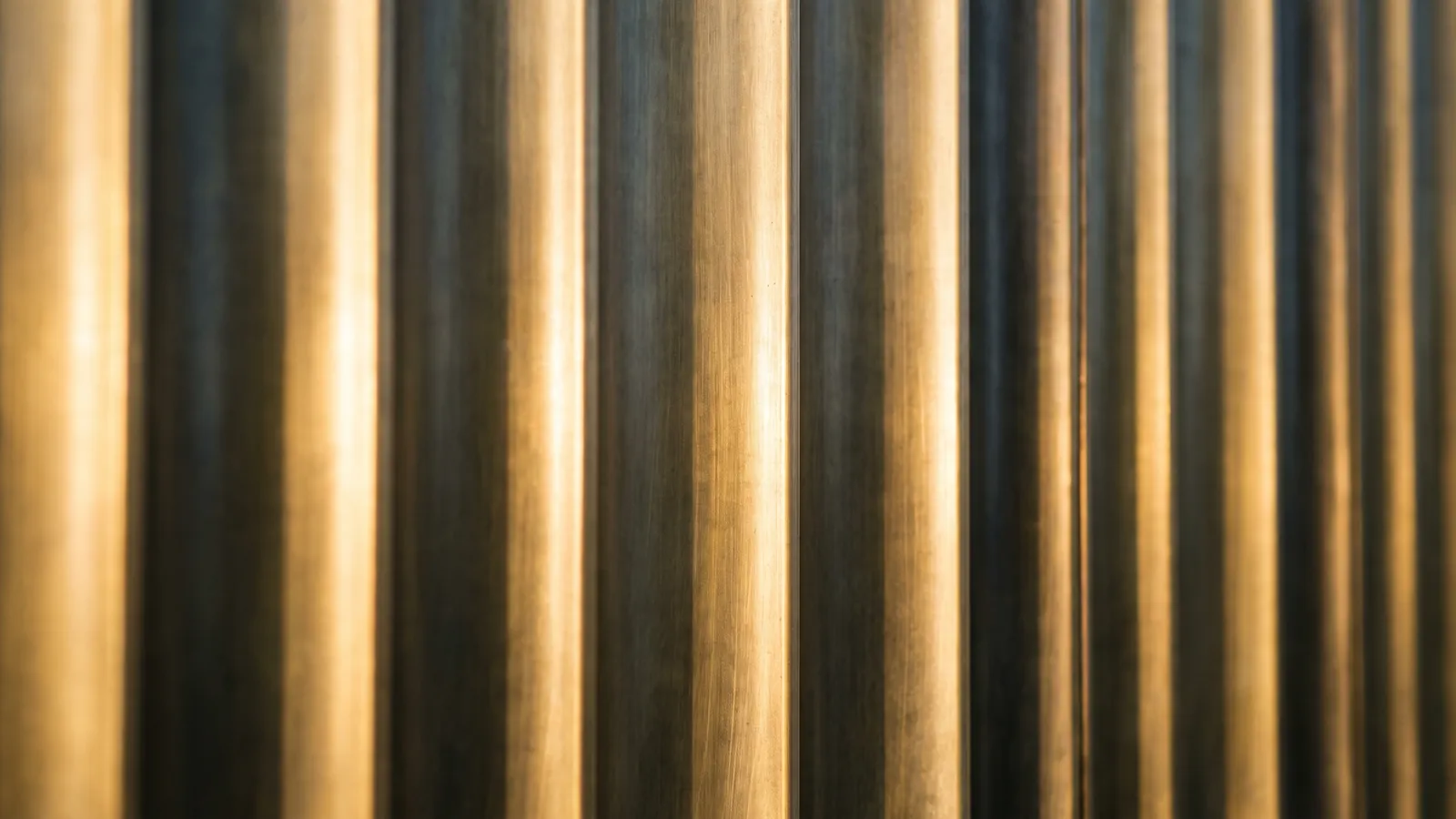
Fluted and textured metal panels
Some metal surfaces are made to sit quietly flat. Others are shaped to catch the light. Fluted and textured metal belongs to the second kind. Run a series of flutes across a brass wall and the plane becomes a rhythm of light and shadow that shifts as you cross the room. This guide sets out what fluted and textured metal is, how it is made and where it belongs.
What fluted and textured metal is
Fluted and textured metal is sheet or plate worked into a repeating relief, so the surface carries depth rather than lying flat. The relief might be a run of soft channels, a crisp fold, a beaten hammer pattern or a fine embossed grain. Texture gives metal shadow, and shadow gives it presence.
There is a practical gain as well. A flat metal panel shows everything: a fingerprint, a light scratch, a faint ripple across a large sheet. Texture breaks up the reflection, so handling and small marks read far less than on a mirror-flat plane. On a reception desk or a lift door, that is a quiet advantage.
The vocabulary: fluted, reeded, ribbed and beyond
The words for textured metal are often used loosely, so it helps to set them straight.
Fluted means a run of concave channels, like the grooves on a classical column, soft and rounded. Reeded is the reverse: convex, raised half-round beads that sit proud of the surface, sharper and more decorative. Ribbed is a bolder, regular relief of raised lines or ridges. Corrugated is the deepest of the linear textures, a continuous wave rolled across the sheet. Hammered metal carries an irregular, hand-beaten pattern of small facets, and embossed metal is pressed with a repeating motif.
The useful split is linear against organic. Linear textures, fluted, reeded, ribbed and corrugated, run in one direction and give a surface a clear grain. Organic textures, hammered and many embossed patterns, sit without direction and feel softer and more handmade.

How the texture is made
Texture is worked into metal in a few established ways, and the method sets the look.
Roll-forming passes a flat sheet through shaped rollers that press a continuous profile along its length. It is how most fluted, ribbed and corrugated sheet is made, and it suits long, even runs. Press-brake folding creates each fold as a straight, crisp crease against a tooled edge, a sharper relief that suits wider ribs and facets. Bespoke tooling is where a pattern belongs to one project: a die or roller is cut to a chosen profile, so a flute width or reed spacing suits one scheme. Casting forms the relief in the mould, so the texture is part of a solid piece for deep, sculptural panels. Most architectural work uses the first three.
Materials and finishes
A texture is only half the surface. The metal and the finish carry the rest.
Brass gives fluting a warm, golden line and ages gracefully, as our brass finishes note sets out. Bronze reads deeper and browner, quieter and more architectural, and takes a patina beautifully; there is more in our architectural bronze guide. Stainless steel is the durable choice for busy and wet areas and holds a texture crisply, across the full run of stainless finishes. Aluminium is light, useful on a large clad wall or lift car.
Finish then sets the mood. A brushed surface keeps the reading soft, so the texture does the work, not the shine. A mirror finish sharpens every highlight along a flute. Blackened metal sinks the plane into shadow and lets only the raised edges catch light, and a patina adds age. A PVD colour, applied by PVD coating, can be carried across the texture in gold, rose, bronze or a near-black, in a hard, scratch and tarnish-resistant surface that rides every ridge.
How light moves across a fluted surface
The reason to choose fluting is what it does with light, and that changes through the day. In the morning, with low, raking light, the flutes throw long soft shadows and the surface reads at its most sculptural. At midday the shadows shorten and the plane calms, showing more of its colour and less of its relief. As the light drops in the evening, the shadows lengthen and the wall comes back to life. Move across the room and the same happens in miniature, each step shifting the highlight along the flutes. A fluted wall rarely feels flat the way a plain panel can; it answers the light it is given, with no backlight and no moving part.

Where fluted and textured metal works
Fluted and textured metal is at its best where a surface is seen closely and wants presence without pattern. Feature walls are the natural home: a run of fluted brass or bronze gives a lobby or a private room a single, quiet, textured plane. Reception and bar fronts take texture well, and the relief hides the daily marks of a working counter. Lift and door faces are a strong fit, turning an everyday surface into something considered while shrugging off fingerprints. Column casings gain a finished vertical rhythm, and joinery faces gain a depth a flat panel could not offer. Across larger elevations, ribbed and corrugated profiles move into metal cladding, where the same relief gives a facade its grain and shadow line.

Scale, flatness and joints
Texture makes its own demands, and they are worth settling early. Scale comes first. A flute that looks right on a sample can look busy across a whole wall, or too coarse on a narrow column, so the width, depth and spacing want judging at full size. Flatness is next. A textured sheet still has to sit flat across its backing without oil-canning, the slight rippling a large thin panel can show; the right gauge, a considered fixing and a proper substrate keep the plane honest. Joints are the last detail, often deciding whether a run reads as one surface. On a linear texture the flutes must line up across each joint, so the eye reads a continuous grain, and any shadow gap or trim is set out with the flutes, not across them.
Working with Dekap
If you are asking whether we make this, the answer is yes. Dekap designs, makes and finishes fluted and textured metal panels to order, to a chosen pattern, in any metal and finish, and to bespoke tooling where a scheme needs a profile of its own.
We form, finish and seal in-house. We cut bespoke flute and reed profiles to suit a project, agree the texture and finish against approved sample plates at full scale, and match the flutes across joints so a run of panels reads as one plane. Where a surface is high-touch or wants a fixed colour, we carry it in PVD, and seal exposed surfaces, where wanted, with our own protective formula developed in the atelier. On one recent feature wall the client wanted fluting that read as deep shadow from the side yet smooth head-on, and we tuned it on samples until it did.
If you are specifying a fluted or textured surface, start a project enquiry and tell us the position, the look you want and roughly how deep the texture should read. We will recommend the pattern, the metal and the finish, not just supply the sheet.
FAQ
What is fluted metal?
Fluted metal is sheet or plate worked into a run of concave channels, so the surface carries a soft relief rather than lying flat. The flutes catch and scatter light, giving the plane shadow and depth, and they help disguise fingerprints and light marks. Fluting is one of a family of textures that also includes reeded, ribbed, corrugated, hammered and embossed metal.
What is the difference between fluted, reeded and ribbed metal?
Fluted metal has concave channels, soft and rounded, like the grooves on a classical column. Reeded metal is the reverse, with convex, raised half-round beads that sit proud of the surface. Ribbed metal is bolder and more regular, a relief of raised lines or ridges closer to a profile than a fine detail. All three are linear textures, running in one direction to give a surface a clear grain.
How is textured metal made?
Textured metal is usually roll-formed, passing a flat sheet through shaped rollers that press a continuous profile along its length, or press-brake folded for a sharper, more angular relief. Bespoke tooling lets a flute width, reed spacing or embossed motif be cut for a single project. Deeper, sculptural surfaces can also be cast, so the relief is part of a solid piece rather than pressed into sheet.
Can fluted and textured metal have a colour or PVD finish?
Yes. Fluted and textured metal can be brushed, mirror-polished, blackened or patinated, and it can carry a hard PVD colour in gold, rose, bronze, champagne or a near-black. Colour works especially well on a textured surface, because the relief already breaks the light and the colour rides every ridge. PVD is also scratch and tarnish-resistant, which suits high-touch positions.
Where are fluted and textured metal panels used?
Fluted and textured metal is used for feature walls, reception and bar fronts, lift and door faces, column casings and joinery faces, where a surface is seen closely and wants presence without pattern. The relief also hides the daily marks of a working surface. Across larger elevations, ribbed and corrugated profiles are used as metal cladding, giving a facade its grain and shadow line.
Does Dekap make fluted or textured metal?
Yes. We design, make and finish fluted and textured metal panels to order, to a chosen pattern, in any metal and finish, and to bespoke tooling where a scheme needs a profile of its own. We finish in-house, agree the texture and finish on approved full-scale sample plates, match the flutes across joints so a run reads as one plane, and can carry a hard PVD colour for high-touch positions. We also seal exposed surfaces, where wanted, with our own protective formula.
Specifying a fluted or textured surface?
Tell us the position, the look you want and roughly how deep the texture should read. We will recommend the pattern, the metal and the finish, not just supply the sheet.
Start a project enquiry