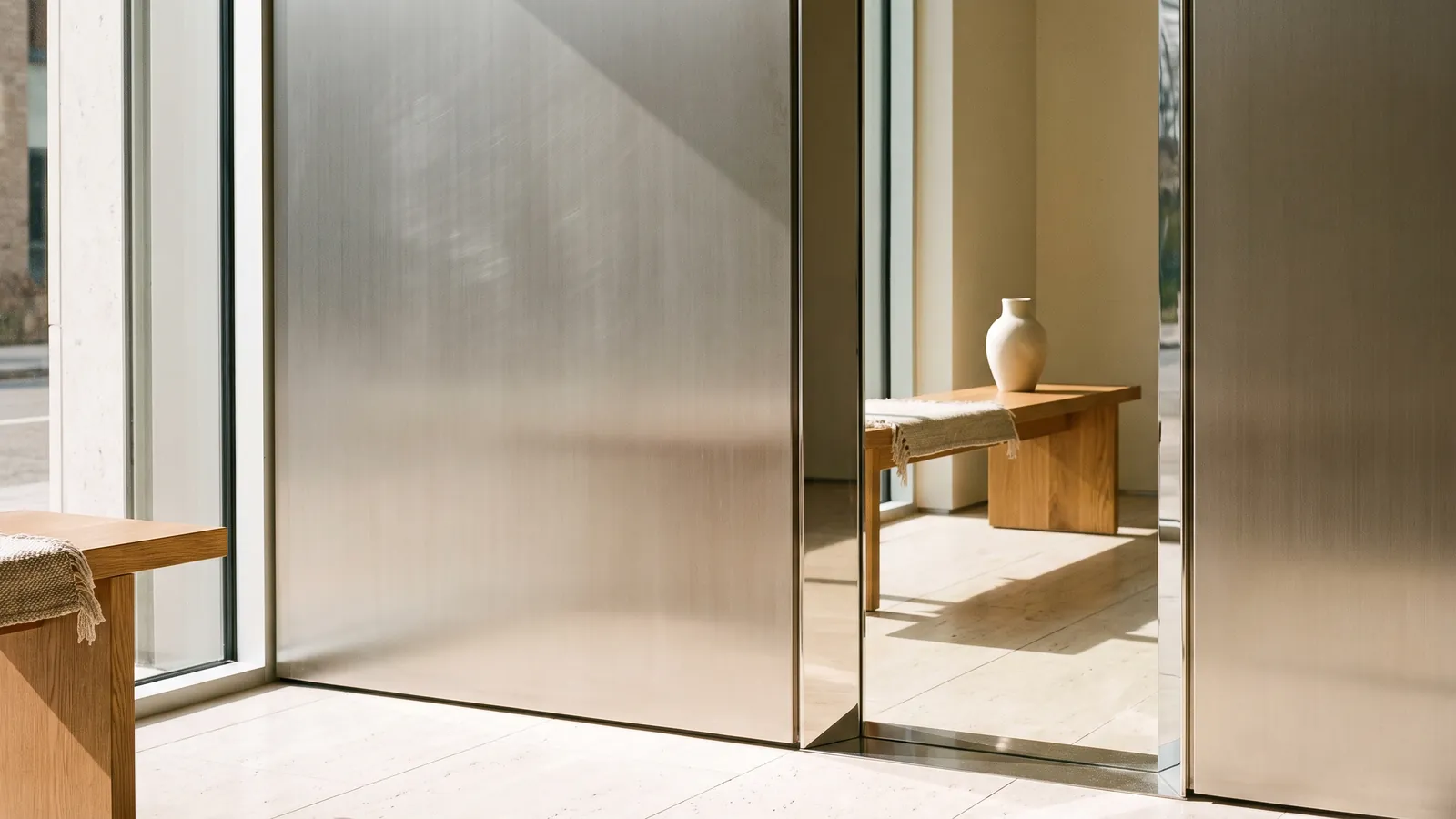
Stainless steel finishes for architecture
Stainless steel is one material with many faces. The same sheet can arrive as a dull grey mill surface, leave the workshop as a soft directional satin, or read as a mirror so clean it doubles the room. None of that is a change of metal. It is a change of finish. For an architect or designer specifying stainless for a facade, a lift car, a reveal or a reception desk, the finish decides how the surface holds light, how it wears, and how often it shows a hand. This guide sets out the finishes we work with and how each behaves in a building.
What sets a finish: direction, texture, reflection
Three things separate one stainless finish from another. Direction is whether the surface carries a grain, and which way it runs. A brushed grain has a clear line; a bead-blasted surface has none. Texture is how coarse or fine that working is, from a deep abrasive grain to a near-invisible one. Reflection is how much light the surface returns, from a flat matte to a full mirror. Read a finish by those three and most of the confusion around trade names falls away. A finish is also practical, not only visual. The same three qualities decide whether a wall hides fingerprints or catalogues them.

Mill, 2B and BA finishes
These are the mill finishes, the state stainless is in before any decorative working. Mill or hot-rolled surfaces are dull and grey and rarely used on show. 2B is the standard cold-rolled finish: smooth, low-reflective, slightly grey, the everyday sheet most stainless starts from. BA, bright annealed, is smoother and more reflective again, a soft near-mirror produced in the rolling rather than by polishing. In architecture 2B and BA are used where a quiet, uniform surface is wanted, and BA is often the base we take up to a mirror or send for colour, because a cleaner starting surface gives a cleaner final finish.
Brushed and satin (No.4, hairline)
Brushed stainless is the workhorse of the palette, and the one most people picture. It carries a fine directional grain that scatters light into a soft, even sheen and, crucially, hides fingerprints and minor marks along the line of the grain. No.4 is the standard architectural brushed finish, a medium satin grain. Finer than that sits satin and hairline, a long, subtle, almost silky grain used where a quieter, more refined line is wanted. In our workshop the grain direction is set deliberately and kept consistent across a run, because a panel brushed across the wrong axis fights every neighbour on the wall. Brushed and satin are the finishes we reach for first on high-touch, high-traffic work, and honestly they are what stainless does best.

Mirror and super mirror (No.8, 8K)
Polish the grain out entirely and stainless becomes reflective. No.8, the standard mirror finish, is bright and clear. Super mirror, sometimes called 8K, is polished further to a deeper, optically flatter reflection that behaves almost like glass. Mirror stainless is beautiful and demanding in equal measure. It shows every fingerprint, every smear and every ripple in the substrate, so it wants a flat, well-supported panel and a client who accepts that it will be cleaned. We use it where reflection is the point: a feature wall meant to carry the light of a space, or a mirror base under a rich PVD colour, where the gloss gives the colour its depth.
Bead blasted and textured
Bead blasting takes the surface the other way, into an even, directionless matte. Fine glass beads are fired at the steel to leave a soft, uniform, non-reflective grey with a gentle tactile texture and no grain to line up. It is calm and architectural, forgiving of fingerprints, and it reads the same from every angle, which suits large plain areas and sculptural pieces. Beyond blasting sit the patterned and embossed textures, rolled or pressed reliefs that break up light across a bigger surface. These are worth knowing when a plain sheet would look flat over a large span, though they are a stronger design statement and should be chosen for a reason, not defaulted to.
Coloured stainless (PVD)
Colour is a finish too. Stainless can be given a true, permanent metal colour, gold, bronze, black, blue and more, by PVD, a thin film grown into the surface in a vacuum chamber rather than painted on top. It keeps the surface finish beneath it, so a PVD gold reads deep on a mirror and soft on a satin, and it carries the hardness and corrosion resistance of the steel. This is the route to warm and dark metal tones on large, high-traffic or exterior surfaces without the weight or tarnish of solid brass. We cover the method in coloured stainless steel, the palette on the PVD colours page, and the documented performance on the PVD coating page.

Choosing a finish by use: fingerprints, traffic, marine
Specify the finish to the position, not the mood board. For high-touch surfaces, lift interiors, door furniture, counters and balustrades, a brushed, satin or bead-blasted finish hides marks and cleans easily; a mirror in the same place becomes a maintenance job. For feature surfaces meant to reflect and be seen, not touched, mirror and super mirror earn their place. For exterior and marine positions the substrate matters as much as the finish: marine-grade stainless such as 316 is specified for coastal air, facades and anything near water, in whichever finish suits the design. One thing we have learned on projects near the sea is that a coarse texture holds salt and grime in a way a finer surface does not, so on exposed elevations we tend to steer clients toward finishes that shed dirt and clean simply. Finish and cladding decisions run together, which is why we treat surface as part of the metal cladding specification rather than an afterthought.
Stainless steel finishes with Dekap
If you are asking whether we make this, the answer is yes. This guide reflects how we finish and specify stainless steel in our own workshop. Dekap produces architectural stainless to order across the full range, mill, 2B and BA, brushed and satin, mirror and super mirror, bead blasted and textured, and colours it by PVD in-house. We match every finish against approved sample plates so it is signed off before production, and we keep grain direction consistent across a run. Where a surface is high-touch or high-gloss, we seal it with our own protective formula, developed in the atelier to hold the finish and resist fingerprints and marking longer than a bare surface. Where a warm or dark metal tone is wanted at scale, we carry it as a hard, colour-stable PVD finish, or guide the specification there.
If you are specifying stainless steel for a current project, start a project enquiry, and tell us the finish, the substrate and the position. We will recommend the finish, not just supply it.
FAQ
What finishes does stainless steel come in?
Stainless steel comes in mill finishes such as 2B and bright annealed, brushed and satin finishes such as No.4 and hairline, mirror and super mirror (No.8 and 8K), bead blasted and textured finishes, and coloured PVD finishes in tones like gold, bronze and black. Each differs in grain direction, texture and how much light it reflects.
What is the difference between brushed and satin stainless?
Both carry a directional grain that softens reflection and hides marks. Brushed, typically No.4, has a medium, clearly visible grain. Satin and hairline are finer, with a longer, subtler, almost silky line. They are points on the same scale, brushed being coarser and more textured, satin being smoother and quieter.
Which stainless finish hides fingerprints best?
Bead blasted and brushed or satin finishes hide fingerprints best, because a matte or grained surface breaks up marks rather than holding them. Mirror and super mirror finishes show fingerprints most, which is why reflective stainless suits feature surfaces that are seen rather than touched.
What is the difference between mirror and super mirror?
Mirror, or No.8, is a bright, clear reflective finish. Super mirror, sometimes called 8K, is polished further to a deeper, optically flatter reflection that behaves almost like glass. Super mirror gives a richer reflection and, as a base under PVD colour, more depth, at the cost of showing every mark and any ripple in the panel.
Can stainless steel be coloured?
Yes. Stainless is coloured by PVD, a thin, permanent metal film grown into the surface in a vacuum chamber. It gives true gold, bronze, black, blue and other tones while keeping the finish beneath it and the hardness and corrosion resistance of the steel. It is not paint and does not chip or peel the way a coating on top would.
Does Dekap make stainless steel finishes?
Yes. We produce architectural stainless across the full range, mill, 2B and BA, brushed and satin, mirror and super mirror, bead blasted and textured, and colour it by PVD in-house, all matched against approved sample plates and signed off before production. We seal high-touch and high-gloss surfaces with our own protective formula for longer-lasting, fingerprint-resistant finishes, and document the substrate and finish for contract-grade specification.
Specifying stainless for a project?
Tell us the finish, the substrate and the position. We will recommend the finish, not just supply it.
Start a project enquiry