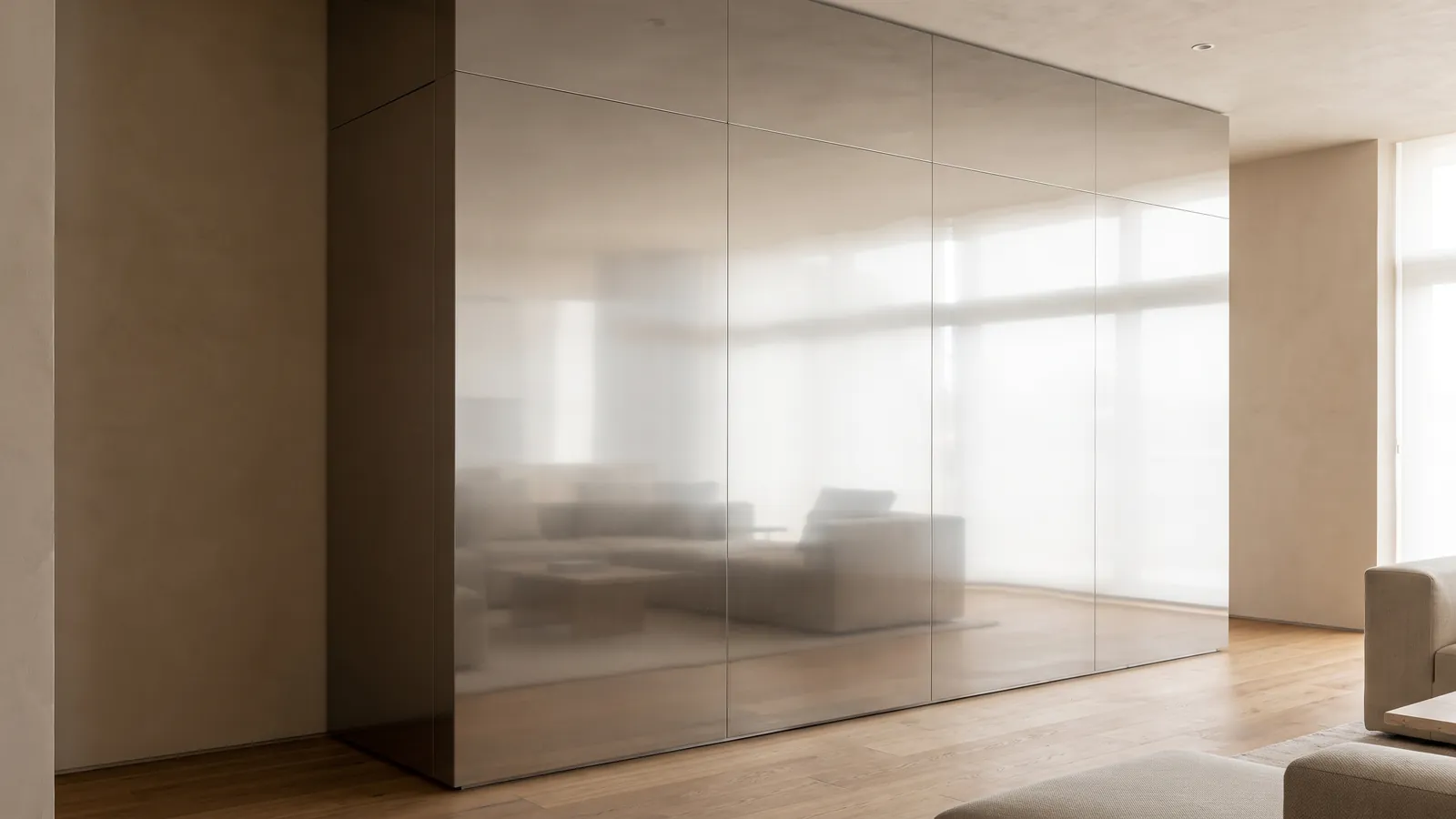
Mirror-polished metal in interiors
A mirror-polished surface is the most demanding thing metal can do, and often the most rewarding. Bring a sheet of stainless, brass or bronze to a true mirror and it stops behaving like a wall and starts behaving like light: it gathers a room, doubles it, and hands it back brighter. For an architect or designer thinking about a feature panel, a ceiling or a reception front, mirror-polished metal adds depth and drama without adding bulk. It is also unforgiving, and worth understanding before it is specified. This guide sets out what a mirror finish is, what it does in a space, and where it earns its place.
What mirror polishing is, and how it is done
A mirror finish is not a coating or a plating. It is the metal itself, polished until the surface returns light cleanly rather than scattering it. Getting there is a progression: the surface is worked through finer and finer abrasives, each stage removing the scratch pattern left by the last, until a very fine final polish lifts the metal to a bright, clear reflection. On stainless this is the No.8 mirror, the brightest of the stainless steel finishes; taken further to a deeper, optically flatter reflection it becomes the super mirror, sometimes called 8K, which behaves almost like glass. Brass and bronze follow the same route, reflecting with their own warm colour rather than a neutral silver. A mirror is earned by preparation: a flatter, cleaner base gives a truer reflection.
What a mirror surface does to a room
Reflection changes how a space is read. A mirror-polished panel borrows the light and colour around it, so a warm room reads warm in the metal and a bright one reads bright. It adds depth where there is none, opening a wall into the space it reflects, and it can make a small or enclosed room feel larger by doubling what stands in front of it. Used with restraint, that is quiet and expansive; used boldly, on a full feature wall or a ceiling, it turns theatrical, catching movement and the shift of daylight across a day. The effect is strongest when the reflection is calm, which comes back to flatness: a true, well-supported mirror gives a clean image, while a panel with any waviness gives a restless one.
Mirror across metals: stainless, brass, bronze and PVD colour
Mirror is a finish, not a metal, so it can be taken across the palette. Mirror stainless is the neutral, hard-wearing reflection, silver-bright and stable. Mirror brass brings a warm, golden reflection and mirror bronze a darker, browner one, both richer than stainless and both living materials that mellow over time unless protected. Then there is coloured mirror. Stainless can be given a true, permanent metal colour by PVD, and when that colour is grown over a mirror base the result has real depth: a gold, bronze or black that reflects like glass and carries the colour into the reflection. A mirror gold reads deep and jewel-like in a way a satin gold never will. We cover the colour route in the coloured stainless steel article and the full palette on the PVD colours page.

The honesty of a mirror
A mirror hides nothing, and that is the whole bargain. It shows every fingerprint, smear and speck of dust while it waits to be cleaned. It also shows the substrate: any ripple, weld line or unevenness beneath the surface is doubled and lit by the reflection, so a mirror is only ever as flat and true as the panel under it. This is why mirror work is as much about fabrication and handling as about polishing. The panel has to be flat and well supported, the joints considered, and the surface protected in transit and on site so it reaches the wall unmarked. None of this is a reason to avoid mirror. It is the reason to plan for it.
Where mirror works, and where it does not
Specify mirror to the position, not only the mood board. It is at its best where it is seen rather than touched: a feature panel that carries the light of a room, a reflective ceiling that lifts a low space, a bar or reception front read from a step back, or a tight jewel-box room where the doubling of the space is the point. It is harder to justify on large, flat, high-touch walls in daily traffic, where hands and cleaning become a constant job, unless the surface is a hard PVD colour that shrugs off marks more readily. Match the finish to how the surface will be lived with, and mirror stays a pleasure rather than a chore.
Pairing mirror with satin
Mirror does not have to carry a scheme alone. One of the most useful moves in the palette is to pair a mirror with a satin or brushed finish in the same metal, using reflection where it counts and the quieter grain everywhere else. A mirror reveal against a satin field, a mirror inlay in a brushed panel, or a mirror band framing a matte surface all give the sparkle of reflection without turning every surface into a mirror to be maintained. The contrast flatters both: the satin looks softer, the mirror brighter. It is a considered way to control how much reflection a room actually needs, and usually the answer is less than a full mirror wall and more than none.

Care and protection
A mirror rewards a little discipline. Kept clean it stays brilliant; left to fingerprints it looks tired quickly, so the honest advice is that any mirror surface will be cleaned. Two things make life easier. The first is PVD colour: a hard PVD film over a mirror base resists marking and wear far better than a bare polished metal, and holds its brilliance with less fuss, which is why coloured mirror is often the practical choice on anything within reach. The second is a protective layer: on brass and bronze in particular, a mirror will tarnish over time unless it is sealed, and a good protective treatment holds the reflection and slows fingerprints on any metal. We keep fuller guidance in the caring for metal finishes article, and the documented performance of the hard-wearing route on the PVD coating page.

Mirror-polished metal with Dekap
If you are asking whether we make this, the answer is yes. Dekap produces mirror-polished metal to order in stainless, brass and bronze, and in mirror PVD colour, polished flat and true and matched to an approved sample plate before production. We treat flatness and handling as part of the finish, so the panel reaches the wall reflecting cleanly and evenly. Where a mirror will be touched, we carry it as a hard, colour-stable PVD finish or seal it with our own protective formula, developed in the atelier to hold the reflection and resist fingerprints longer than a bare surface. And where a warm or dark mirror is wanted at scale, we grow the colour over the mirror by PVD so it keeps its depth without the tarnish of solid brass.
If you are considering mirror-polished metal for a current project, start a project enquiry, and tell us the metal, the colour and where the surface will sit. We will recommend the finish, not just supply it.
FAQ
What is mirror-polished metal?
Mirror-polished metal is metal worked through progressively finer abrasives until the surface returns light cleanly and reflects like a mirror. It is the metal itself, not a coating. On stainless it is known as the No.8 mirror, or the deeper super mirror (8K); brass and bronze can be polished to a mirror too, reflecting with their own warm colour.
What is the difference between mirror and super mirror?
Mirror, or No.8 on stainless, is a bright, clear reflection. Super mirror, sometimes called 8K, is polished further to a deeper, optically flatter reflection that behaves almost like glass. Super mirror gives a richer image and, as a base under PVD colour, more depth, at the cost of showing every mark and any unevenness in the panel.
Does a mirror finish show fingerprints?
Yes. A mirror hides nothing, so it shows fingerprints, smears and dust, and it doubles any ripple or unevenness in the panel beneath. That is why mirror suits surfaces that are seen rather than touched, why the panel must be flat and well supported, and why a hard PVD colour or a protective layer helps where the surface will be handled.
Where does mirror-polished metal work best in an interior?
Mirror works best where it is seen rather than touched: feature panels, reflective ceilings, bar and reception fronts, and tight jewel-box rooms where doubling the space is the point. It is harder to justify on large, flat, high-touch walls in daily traffic unless it is a hard PVD colour, and it pairs well with a satin finish to control how much reflection a room carries.
Can you get a mirror finish in colour?
Yes. Stainless can be given a true, permanent metal colour by PVD, and grown over a mirror base it produces a coloured mirror, a gold, bronze or black that reflects like glass and carries the colour into the reflection. A hard PVD film over a mirror also resists marking better than a bare polished surface.
Does Dekap make mirror-polished metal?
Yes. Dekap produces mirror-polished metal to order in stainless, brass and bronze, and in mirror PVD colour, polished flat and true and matched to an approved sample plate before production. We treat flatness and handling as part of the finish, and where a mirror will be touched we carry it as a hard, colour-stable PVD finish or seal it with our own protective formula to hold the reflection and resist fingerprints longer.
Considering mirror-polished metal?
Tell us the metal, the colour and where the surface will sit. We will recommend the finish, not just supply it.
Start a project enquiry