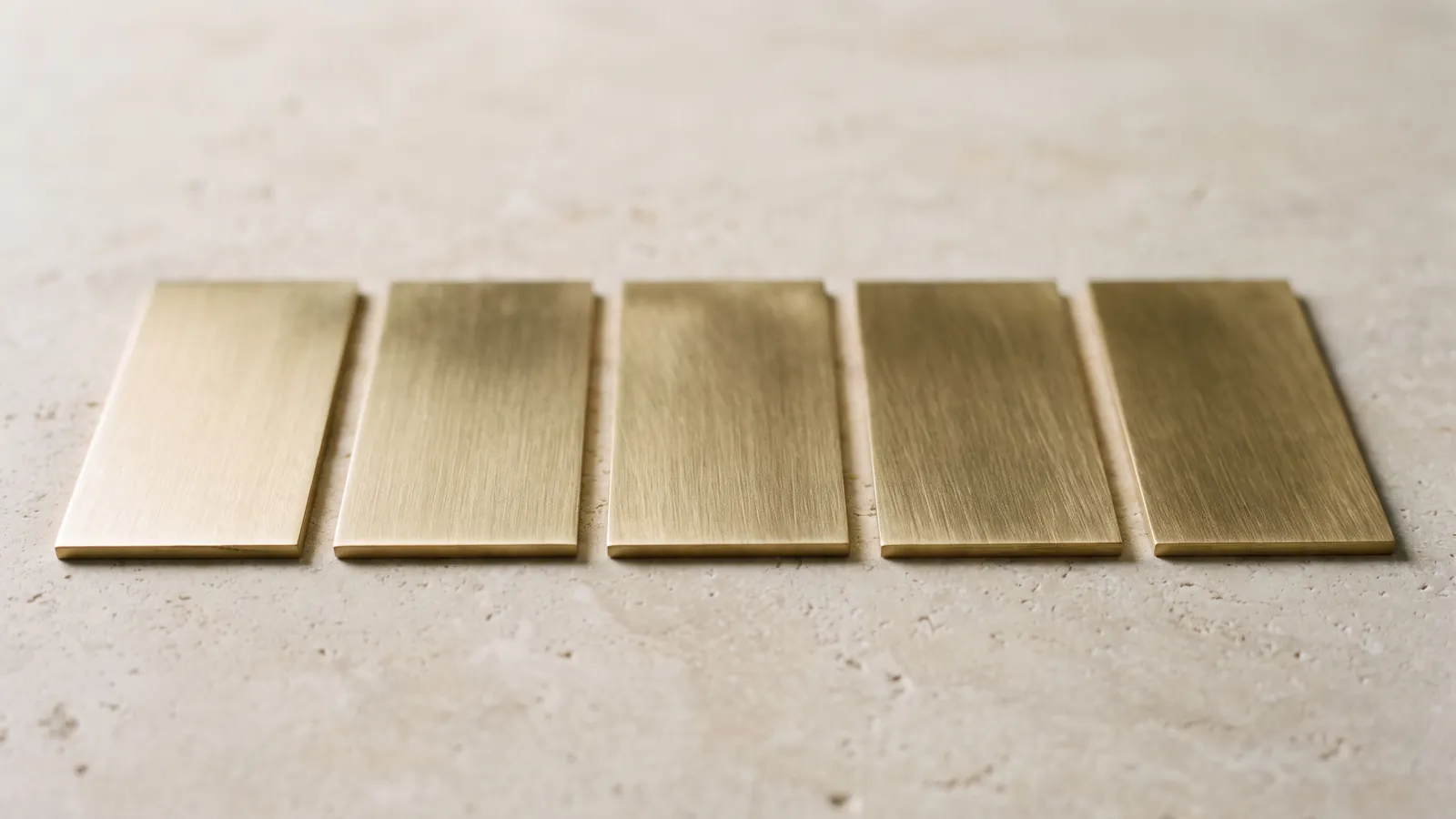
Matching metal finishes across a project
The hardest part of a metal spec is rarely the finish itself. It is getting the finish to read the same across every piece, every panel and every room. A single sample looks convincing on a desk. A project asks for fifty of them, made over weeks, in more than one metal, seen under changing light, and expected to look like one decision. That is a different problem, and it is where most finish specifications quietly fail. This guide sets out why matching is difficult, where the variation comes from, and how to control it so a scheme holds together.
Why matching is the hard part
A metal finish is not a paint code. It is the result of an alloy, a mill batch, a grain, a set of operations and a light. Change any one of them and the surface shifts, sometimes by a little, sometimes by enough to catch the eye. On a small job the eye forgives it. On a large one, where two panels sit side by side or a handle meets a plate, a mismatch reads as a fault even when each piece is faultless on its own. Matching is the discipline of removing that variation, or agreeing it, before anything is made at scale. For the language of specifying a single finish, see how to specify a metal finish; this article is about holding that finish across a whole project.
Where the variation comes from
It helps to name the sources, because each is controlled differently.
Alloy and mill batch. Two coils of the same grade from different heats can carry slightly different tone and brightness. Brass and bronze vary more than stainless. Buying the metal for a project from one batch, where possible, removes a whole layer of drift.
Grain direction. A brushed or satin finish has a direction. Run the grain one way on one panel and across on its neighbour and they look like two different metals under the same light, because they reflect it differently.
Finish operator and method. A hand-worked finish carries the hand that made it. Pressure, belt wear and pace all move the result. Consistency comes from method, sequence and the same setup, not from hoping.
PVD chamber batch. A PVD colour is laid in a vacuum chamber, and colour can shift subtly between chamber loads. Running matched pieces in the same load, and proving colour against a reference, is how the tone is held. See the PVD colour range for what is being matched.
Lighting. The same panel reads warm under one lamp and cool under another. Much of what looks like a mismatch is really two surfaces seen under two lights.
The approved control plate
The single most useful tool in finish matching is a physical reference that everyone signs off before production. Call it the control plate. It is a made sample, in the actual metal and the actual finish, agreed by the client and the maker as the target. Once approved, it is not a mood piece. It is the standard every batch is checked against, under agreed light, for the life of the job. Nothing goes to production until the control plate is signed, and nothing ships that does not sit against it. This is the difference between a finish that was chosen and a finish that is controlled.

Grain direction and orientation on site
Grain is decided on the drawing, not on the bench. For any directional finish, the specification should say which way the grain runs on each element, and how adjoining pieces relate. Vertical on cladding, along the length of a handle, aligned across a run of panels: these are choices, and if they are not made, they are made for you by whoever loads the machine. Orientation on site matters just as much. A panel installed upside down or rotated can break a match that was perfect in the workshop, so pieces are marked for orientation before they leave.

Batching and sequencing
Where a finish carries any batch variation, the fix is to plan the batch. Pieces that will sit together are made together, from the same metal, in the same run, and kept as a set through finishing and, for PVD, through the same chamber load. Panels are laid out and sequenced so that any gentle drift runs along the elevation rather than jumping between neighbours. It is far easier to control a set than to match a stranger to it later.
Matching across substrates and conditions
Some of the hardest matches are between different things asked to look the same. A solid brass handle next to a brass-tone PVD stainless plate is two materials, two processes and two ways of catching light, brought to one tone. It can be done, but it is agreed on samples first, not assumed. The same applies to stainless steel finishes meeting coloured stainless steel, or brass finishes that will age, and to interior pieces meeting exterior ones. Outdoor metal weathers and sees daylight; indoor metal stays put under lamplight. Matching across that boundary means deciding how far the two are allowed to diverge over time, and saying so.

Documentation and what to state on a drawing
A match that lives only in someone's memory will not survive a project. Contract-grade specification writes it down: the metal and grade, the finish and its reference, the grain direction per element, the approved control plate and its sign-off, the batch and sequencing intent, and the viewing conditions used to judge it. On the drawing itself, state the finish reference, the grain direction, and a note that all pieces are matched to the approved control plate under agreed lighting. That single sentence, backed by a signed plate and a recorded finish, is what turns a good sample into a project that reads as one hand.
Working with Dekap
If you are asking whether we can hold a finish across a whole project, the answer is yes. Dekap works from approved control plates, records the finish so it can be repeated, controls grain direction and batch through production, and documents all of it for contract-grade specification. We agree the target on real sample plates before anything is made, keep matched pieces as a set through finishing and, for PVD on stainless, through the same chamber load, and mark pieces for orientation so a match made in the workshop survives installation. We will not overclaim a perfect match between two very different substrates without proving it on samples first, because an honest sample is worth more than a confident promise.
If you are specifying finishes for a live project, start a project enquiry, and tell us the metals, the finish and where the pieces have to agree. We will set the control plates and the batch plan, not just supply the metal.
FAQ
Why is it hard to match metal finishes across a project?
Because a metal finish is not a paint code. It is the result of an alloy, a mill batch, a grain direction, the finishing method and the light it is seen under. Any of these can shift between pieces made at different times, so a finish that looks convincing on one sample can drift across fifty. Matching is the discipline of removing or agreeing that variation before anything is made at scale.
What is a control plate and why does it matter?
A control plate is a physical sample, made in the actual metal and finish, that the client and maker sign off before production as the agreed target. Once approved it becomes the standard every batch is checked against, under agreed lighting, for the life of the job. Nothing goes to production until it is signed, and nothing ships that does not sit against it.
Why does grain direction affect matching?
A brushed or satin finish reflects light along its grain. If the grain runs one way on one panel and across its neighbour, the two look like different metals under the same light even though the finish is identical. Grain direction should be stated on the drawing for each element and marked on pieces so orientation is correct on site.
Can a solid brass piece be matched to brass-tone PVD stainless?
Yes, within reason, but it is agreed on samples first. Solid brass and brass-tone PVD on stainless are two materials and two processes that catch light differently, so they are brought to one tone rather than assumed to match. Proving it on real sample plates, under the lighting the pieces will live in, is the only honest way to set the target.
What should a drawing say about finish matching?
State the finish reference, the grain direction per element, and a note that all pieces are matched to the approved control plate under agreed lighting. Back it with a signed control plate, a recorded finish that can be repeated, and the batch and sequencing intent. That is what makes a match contract-grade rather than a matter of memory.
Does Dekap guarantee finish matching across a project?
We control it rather than leave it to chance, and we are honest about its limits. Dekap works from approved control plates, records the finish so it can be repeated, controls grain and batch through production, keeps matched pieces as a set and, for PVD, in the same chamber load, and documents all of it for contract-grade specification. Where two very different substrates have to agree, we prove the match on samples first rather than promise a perfect result, so what is agreed is what is delivered.
Holding a finish across a project?
Tell us the metals, the finish and where the pieces have to agree. We will set the control plates and the batch plan, not just supply the metal.
Start a project enquiry