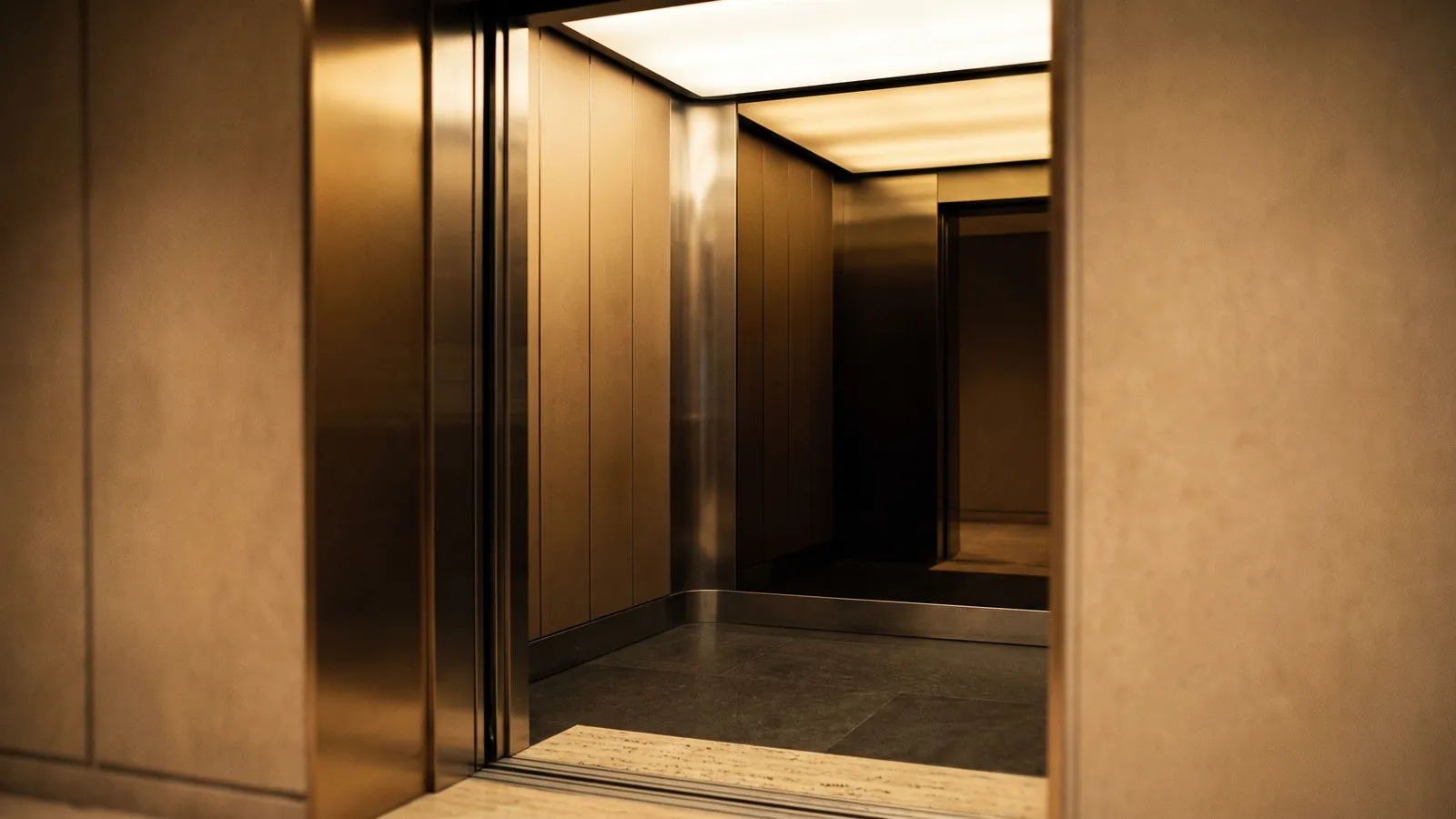
Metal in lift interiors
A lift is the most concentrated room in a building. It is small, enclosed, lit from within and read from an arm's length for the length of the ride. Every surface is seen up close and most are touched. That is why a lift car repays considered metalwork: there is nowhere for a poor join or a tired finish to hide, and nowhere better for a good one to be noticed. This piece looks at how metal is used in lift interiors, the surfaces it covers and the finishes that suit the most-touched space in a building.
The lift as a signature moment
A lobby has a whole room to make its impression. A lift has a box the size of a small wardrobe and a captive audience inside it. That closeness changes what a finish has to do. A surface that reads well across a hall can look flat or coarse at close range, while a considered metal, brushed to an even grain or coloured to a warm depth, rewards the attention it is given. In hospitality, residential and workplace schemes alike, the lift is where a material scheme is inspected most closely, so it is worth treating as a signature moment rather than a service.
The surfaces in a lift car
A lift interior is made of a small number of planes, each with its own demands. The side and rear car walls are the large fields that set the tone, and they take shoulders, luggage and hands all day. The car doors and door frames are the moving faces the guest watches on every floor, and the entrance surround is often the first metal seen from the landing. The ceiling carries the light and, in a taller car, becomes a feature in its own right. The skirting, reveals and returns are the narrow edges where finishes meet and where quality is judged. The control panel surround, the car operating panel, is the one piece touched on every journey, so it deserves the hardest, most fingerprint-tolerant finish in the car. Read together, these surfaces are a family, and the art is in how they are detailed to one another.


Finishes that suit a lift car
Because a lift is close and touched, the finish choice is unusually consequential. Brushed and satin stainless finishes are the workhorses: an even directional grain hides fingerprints and light marks far better than a bright polish, and cleans easily. Coloured stainless by PVD brings warmth in champagne, bronze, rose or graphite without the tarnish that solid brass or copper would show in a humid, hand-touched space. Blackened steel gives a grounded, hand-made depth for a feature wall or ceiling seen more than handled. Brass and bronze bring warmth and craft where a car should feel settled, protected for the environment. Mirror stainless, used with discretion, doubles the perceived size of a small car and lifts the light, though it shows every mark and suits a rear wall better than a high-touch face. The usual scheme mixes them: a tough, quiet field on the walls, a warmer or brighter note where the eye should land.

Durability and fingerprints
No other interior surface is touched as often as a lift. Doors, walls and the operating panel meet hands, sleeves and cleaning cloths through the day, so the honest test of a lift finish is how it looks after a year, not on the day it is installed. Two routes win. Satin and brushed stainless disguise marks in their grain and shrug off cleaning. Coloured stainless by PVD goes further: the colour is a hard, thin, bonded layer fused to the steel, not a plating or a paint, so it resists scratches, tarnish and the constant wiping a lift needs, and holds its tone in a humid, hand-touched box. Where a warm gold is wanted, PVD stands up far better under this contact than a plated finish, worth weighing when you compare gold PVD and gold plating. Softer living finishes still have a place, but on surfaces seen more than gripped.

Coordinating the car with the lift lobby
A lift is really two moments: the landing, where the doors and entrance surround are seen from the lift lobby, and the car, inspected from inside. The two should read as one idea. When the entrance frame on the floor picks up the same finish family as the reception desk or the feature wall, the lift feels part of the architecture rather than a bought-in box. Inside, the car can continue that material or offer a warmer counterpoint, but the decision should be made, not left to a standard cab. Coordinating finish, grain direction and colour across landing and car, and across every floor, is the kind of detail that separates a considered scheme from an assembled one.

Weight, fixing and code
Cladding a lift is not the same as cladding a wall, and the constraints are real. A lift car has a rated load and a defined balance, so the weight of the cladding matters and is agreed with the lift engineer rather than assumed. Panels are fixed back to the car structure with concealed fixings that allow for movement, service access and safe removal, so the detailing is engineered, not merely decorative. Fire performance, smoke behaviour and the relevant lift and building codes govern what can be used inside a car, and these vary by market and by project, so materials and build-ups are confirmed against the specification for each job. We plan finishes around these requirements rather than promising figures in the abstract, and we work with the lift supplier and the design team so the interior meets both the look and the code.

Why coloured PVD stainless is often the answer
Put the demands together, close viewing, constant touch, humidity, cleaning, weight and code, and one finish keeps meeting them: coloured stainless by PVD. It gives the warmth of gold, bronze, champagne or graphite that a lift interior wants, on a stainless base that is stable and hygienic, in a surface hard enough to take a lift's daily life without tarnishing or wearing thin. It is light, it cleans easily, and the colour palette can be tuned to a scheme and repeated across every car in a building. That is why so many considered lift interiors arrive at PVD coloured stainless for the walls and doors, with a warmer living finish kept for the surfaces admired more than touched.

Metal in lift interiors with Dekap
If you are asking whether we make this, the answer is yes. Dekap designs, makes and finishes bespoke lift car interiors and door finishes, coordinated with the lift lobby, in any finish across coloured PVD, brushed and satin stainless, blackened steel, brass and bronze. We match every finish to an approved sample plate before production, protect high-touch surfaces with our own proprietary post-PVD protective layers for longer life in the most-touched space in a building, and detail the panels for fixing to the car structure in coordination with the lift supplier and the design team. We keep client and project detail in confidence, and finishes can be developed to sit within a scheme and repeated across every car in a property.
If you are shaping a lift interior or a wider scheme, start a project enquiry, and tell us the car, the finishes and the programme. We will recommend the approach, not just supply the metal.
FAQ
What metal is used in lift interiors?
Most often stainless steel on the car walls, doors, door frames and ceiling, in brushed, satin, coloured PVD or mirror finishes, with blackened steel, brass or bronze used for features. The control panel surround, skirting and reveals are metal too. In considered schemes these are usually bespoke, made to the design rather than bought as a standard cab.
Which finish is best for a lift car?
For the touched surfaces, satin and brushed stainless and coloured PVD stainless perform best, because their grain and hard surface hide fingerprints and take daily cleaning. Mirror stainless makes a small car feel larger but shows every mark, so it suits a rear wall or panel. Warmer living finishes such as brass and bronze belong where a surface is seen more than gripped.
How do you keep fingerprints off lift doors and walls?
The reliable route is a directional grain and a hard surface. Brushed and satin stainless disguise marks in their grain and wipe clean, while coloured stainless by PVD adds a hard, bonded colour layer that resists tarnish and constant cleaning. Bright polished and mirror surfaces look striking but show every touch, so they are used with care in a lift.
Can lift finishes match the lift lobby?
Yes. The entrance frame and doors seen from the landing, and the interior of the car, can be finished in one family so the lift reads as part of the architecture. Finishes are agreed on approved sample plates, matched for colour and grain direction, and repeated consistently across every floor and every car.
Are metal lift interiors durable, and do they meet code?
Coloured PVD and satin stainless are among the most durable interior finishes for a high-touch space. Cladding weight, concealed fixing to the car structure, and fire and lift and building codes are confirmed for each project with the lift engineer and design team, since requirements vary by market. Materials and build-ups are specified to meet both the look and the code rather than assumed.
Does Dekap make lift interiors?
Yes. We design, make and finish bespoke lift car interiors and door finishes, coordinated with the lift lobby, in any finish across coloured PVD, brushed and satin stainless, blackened steel, brass and bronze. We match finishes to approved sample plates, protect high-touch surfaces with our own proprietary post-PVD layers, detail panels for fixing to the car structure with the lift supplier, and keep client and project detail in confidence.
Shaping a lift interior?
Tell us the car, the finishes and the programme. We will recommend the approach, not just supply the metal.
Start a project enquiry