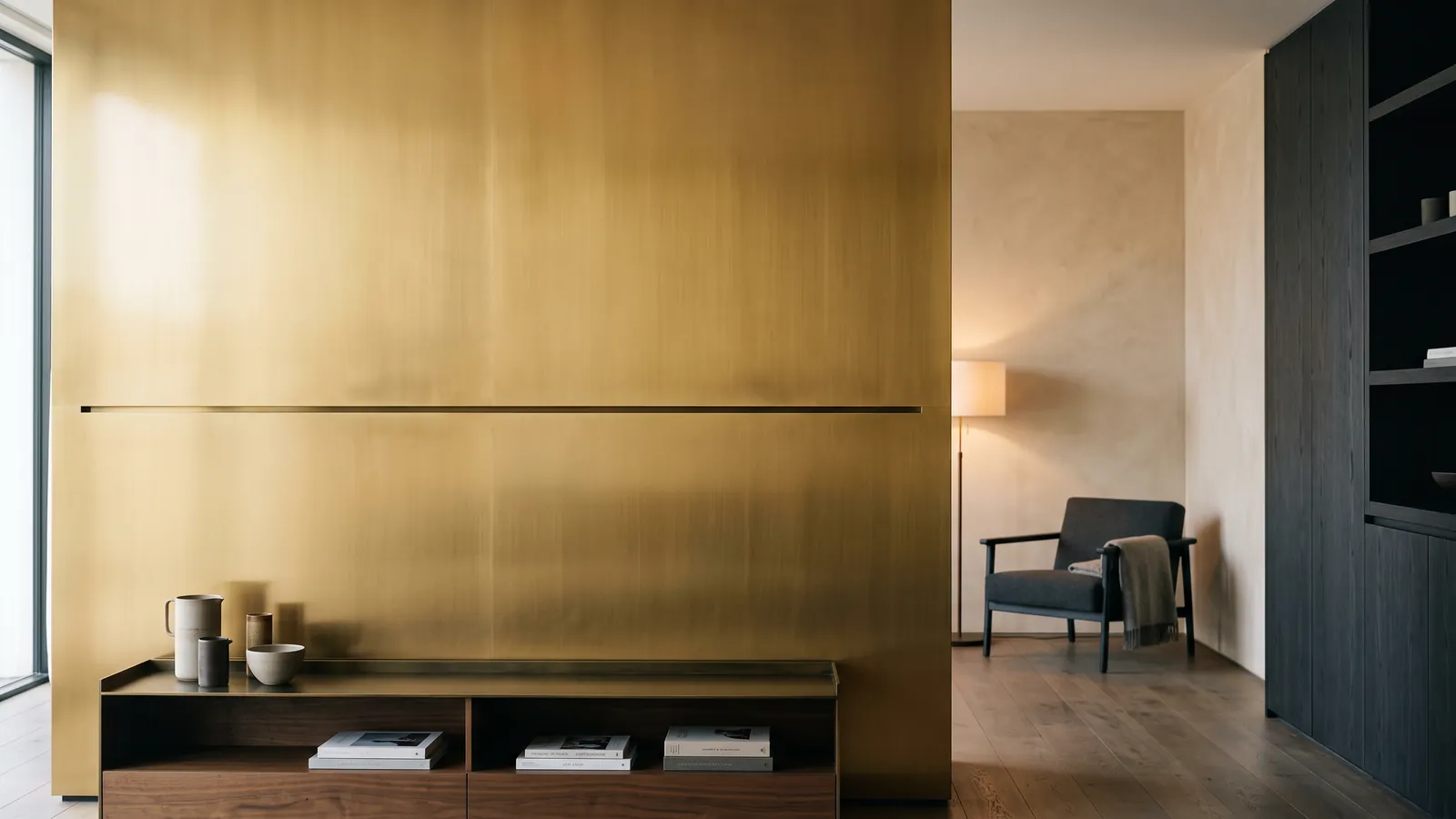
Gold PVD vs gold plating
Gold has two roads onto architectural metal, and they are easy to confuse. One is gold plating, the old electroplated layer of real gold. The other is gold PVD, a hard gold-coloured film grown onto stainless in a vacuum. They can look identical on the day they are made. They do not age the same way, they do not cost the same, and they do not belong in the same positions. For an architect or designer specifying a gold handrail, a reveal or a panelled wall, the choice between them is the whole decision. This guide sets it out plainly.
The look: real gold versus gold tone
On the sample plate, side by side, most people cannot tell them apart. A well made gold plate and a warm gold PVD both read as rich, even, unmistakably gold. The honest difference is not the first impression but the second. Plated gold is a layer of the actual metal, so its colour is the colour of gold itself. Gold PVD is a colour tuned in the chamber, which means the palette is wider: not only classic yellow gold but rose gold, champagne, and a brass tone that solid brass cannot hold without tarnishing. The look, on day one, is a close-run thing. What separates them is everything that happens after.

What gold PVD is
Gold PVD is a colour, not a plating. In a vacuum chamber the source metal is vaporised and bonded onto a stainless steel surface as an extremely thin, fused film. That film carries the gold tone, and because it is grown into the steel rather than laid on top, it keeps the exact surface beneath it, mirror, satin or bead-blasted, and takes on the hardness and corrosion resistance of stainless. It is the same method used for the whole coloured palette, documented with substrates and performance tiers on the PVD coating page. The point worth holding onto: the gold you see is a hard ceramic-like film on a stainless body, not a soft precious-metal skin.
What gold plating is
Gold plating is the traditional route, and the older craft of the two. A thin layer of real gold is deposited electrically onto a base metal, usually brass or another substrate, in a plating bath. The result is genuine gold on the surface, warm and true, and for interior jewellery-grade pieces and fine fittings it has a depth that is hard to fault. Its weakness is physical. Gold is soft, the plated layer is thin, and it sits on top of the base metal rather than fused into it. Handling, abrasion and time wear it down to the metal underneath. It is a beautiful finish that asks to be treated gently.
Durability and wear
This is where the two finishes part company, and it is the reason to choose carefully. Gold plating is soft and wears at the touch points first, edges, handles, the places hands and sleeves return to, until the base metal shows through. Gold PVD is hard, scratch-resistant and colour-stable, and because the film is fused into stainless it holds its colour through handling and cleaning far longer. We will not put a number on either here, because real-world wear depends on position, traffic and the specific specification, and the documented figures live on the PVD coating page. But the direction is not in doubt. For anything touched, walked past or exposed, PVD is the durable finish and plating is not.

Cost
Plated gold carries the cost of real gold, and that cost tracks the metal market and the thickness of the layer. A generous plate is expensive, and a cheap plate is thin and short-lived, a poor economy on a building. Gold PVD is not priced against the gold market, because the film uses very little source material. It is usually the more economical route at architectural scale, and the more predictable one, since the colour holds rather than needing renewal.
Colour range
Plating gives you gold, in the tones of the alloy being deposited. PVD gives you a family. The gold family runs from champagne and light gold through classic yellow to a deeper red gold, and alongside it sit rose gold and a warm brass tone. That range is one of the quieter advantages of PVD: a rose gold or champagne that would be difficult or costly to plate is a settled part of the palette, and it stays constant rather than shifting as it ages. The full set of tones, and how surface finish changes each one, is on the PVD colours page.

Which to use when
Our opinion, after working in both, is straightforward. Specify gold PVD on stainless for almost every architectural position: handrails, cladding, panels, reveals, lift interiors, hospitality and retail, and anywhere exterior or high-touch. It is harder, it holds its colour, it offers more tones, and it usually costs less over the life of the surface. Keep gold plating for the narrow cases where genuine deposited gold is the point, a small, protected, jewellery-grade fitting where the material itself matters and the piece will be handled with care. For the warm gold read that also relates to solid brass, the comparison in brass finishes for architecture is worth reading alongside this.
Gold finishes with Dekap
If you are asking whether we make this finish, the answer is yes, both of them. We have worked in both gold plating and gold PVD in our own workshop, which is why we compare them plainly here. Dekap colours stainless steel gold by PVD in-house, across the gold, rose gold, champagne and brass-tone range and every surface finish, and we still plate where a piece genuinely calls for deposited gold. We match colour and surface against approved sample plates so the finish is signed off before production, and we protect high-touch and high-gloss gold surfaces with our own proprietary post-PVD layers, developed in the atelier for longer-lasting colour and better fingerprint resistance. We document the finish for contract-grade specification, and we guide the choice rather than simply taking the order.
If you are specifying a gold finish for a current project, start a project enquiry, and tell us the tone, the surface, the position and the traffic. We will recommend the finish, not just supply it.
FAQ
Is gold PVD real gold?
Gold PVD is a gold-coloured film, not a layer of solid gold. The colour is created by bonding metal onto stainless steel in a vacuum as an extremely thin, fused film. It reads as true gold and is far harder and more durable than plated gold, but the material itself is a coating on stainless, not deposited precious metal.
Gold PVD vs gold plating, which lasts longer?
Gold PVD lasts considerably longer in almost every architectural position. It is a hard, scratch-resistant film fused into stainless, so it holds its colour through handling, cleaning and exposure. Gold plating is a soft layer of real gold on a base metal and wears through at touch points over time. For anything touched, walked past or exposed, PVD is the durable choice.
Does gold PVD wear off?
Gold PVD is hard and colour-stable, and it does not wear off the way plating does, because the film is fused into the stainless surface rather than sitting on top of it. It resists everyday handling and cleaning. Extreme abrasion can eventually mark any finish, and real-world performance depends on the substrate and specification, which are documented on the PVD coating page.
What gold tones are possible?
The gold family runs from champagne and light gold through classic yellow to a deeper red gold, with rose gold and a warm brass tone alongside. Because PVD colour is tuned in the chamber, tones that are difficult or costly to plate, such as rose gold and champagne, are a settled part of the palette and stay constant as they age.
Is gold PVD food safe?
Certain PVD colours can be specified to meet food-contact or biocompatible requirements, confirmed for the particular application rather than assumed. If a gold surface needs to meet a food-safe or hygienic standard, tell us the requirement at enquiry and we will specify and confirm a suitable finish for that use, rather than treating every PVD gold as automatically qualified.
Does Dekap make gold PVD?
Yes. We colour stainless steel gold by PVD in-house, across the gold, rose gold, champagne and brass-tone range and every surface finish, matched against approved sample plates and signed off before production. We protect high-touch and high-gloss surfaces with our own proprietary post-PVD layers for longer-lasting colour and fingerprint resistance, and we still plate where a piece genuinely calls for deposited gold.
Specifying a gold finish?
Tell us the tone, the surface, the position and the traffic. We will recommend the finish, not just supply it.
Start a project enquiry