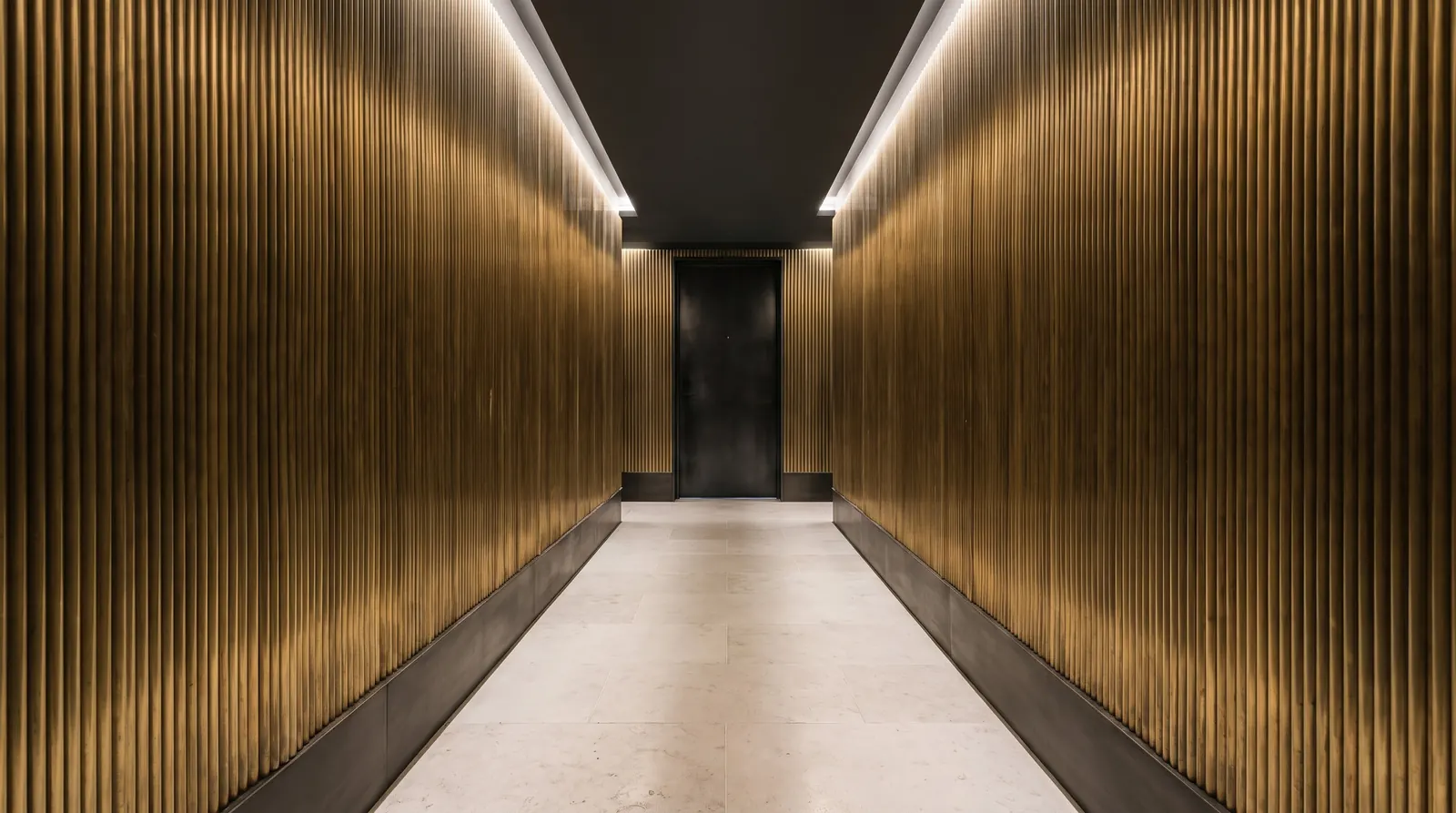
Fluted metal in hotel corridors
Fluted metal gives a long hotel corridor a surface that changes with every step, and with the right profile, finish and joints it takes knocks and cleaning better than most wall coverings.
A corridor is the longest wall in a hotel and the one guests walk beside for the longest time. It is narrow, lit from the side or from above, and used by luggage, trolleys and cleaning machines all day. Those conditions suit fluted metal, and they expose a careless specification quickly.
Why corridors suit fluting
A corridor is mostly one long plane. On flat metal or paint, every ripple and scuff shows, because nothing breaks the reflection. Flutes break it. Light from wall lights, door recesses or a ceiling slot runs along the channels and gives each panel a rhythm of highlight and shadow, so the wall reads as depth rather than as a plain surface.
The second reason is wear. The lower metre of a corridor wall takes trolley strikes, bags and shoulders. A fluted face carries small marks and fingerprints far better than a mirror-flat or smooth satin sheet, and cleaning is simple: wipe along the flutes. The honest limit is dust. A deep, tight profile collects it, so the depth should match the cleaning routine.
Choosing the flute profile
Half-round
Soft, concave channels, like the grooves on a classical column. This is the most forgiving profile. The shadow is gentle, no edge is sharp under a passing hand, and it wipes clean easily.
V profile
Crisp V-shaped grooves give a sharper, more graphic line. The shadow is darker and the pattern reads from further away, which suits a long corridor with a clear end point. The edges are harder, so it suits the upper wall better than the trolley zone.
Flat-ridge
Flat-topped ribs separated by narrow grooves. It looks formal and architectural, and it needs very accurate setting out, because uneven ribs show at every joint.
Pitch and depth
As a starting range, a pitch (centre to centre) of roughly 20 to 50 mm and a depth of 3 to 10 mm suit corridors. A narrow corridor usually wants a finer, shallower pattern, because the wall is seen from close. Judge it on a full-size sample under the real lighting.
Working on a project? Tell us about it and we will suggest the right approach.
Metal and finish
Brass in satin. Brass gives a corridor a warm golden line that stays soft under wall lights, and a satin surface hides marks well. Unsealed, it ages and darkens where hands touch. Sealed, it stays closer to its first colour. Our brass finishes guide sets out the difference.
Blackened steel in matt. A matt blackened surface sinks the plane into shadow and lets only the raised edges catch light. It suits sheltered walls and is normally sealed, so agree the sealing early. More in our note on blackened steel.
PVD colour on stainless steel. PVD is a hard, thin film bonded to the metal in a vacuum chamber. The colour does not tarnish or wear off like paint, and the range runs from gold and rose gold to bronze, anthracite and black (see PVD colours and PVD coating). It is the practical choice for the trolley zone. The flutes are formed first and the part is coated last, because cutting or welding after coating damages the film.
Panel module and joints
Module and panel size
Start from the corridor, not the sheet. Set the module to the door spacing so joints fall on door lines or at a regular rhythm, and give every panel a whole number of flutes so the pattern never ends on half a channel. Floor-to-ceiling panels in one length read best, but sheet size and the forming method limit the length. Ask early.
Reveals, corners and skirting
A shadow-gap reveal at the ceiling and between panels absorbs building tolerance, and corridors have plenty of it. At corners, either mitre the flutes so the pattern turns the corner, or end the panels on a flat folded strip. Pick one and draw it. Metal skirting in the same finish protects the foot of the flutes from trolley strikes and gives the pattern a clean base.
Door frames
End the flutes on a full channel at each frame. Make the frame flat, in the same metal, with a small shadow gap between frame and panel.
Light and shadow
Light decides how the wall looks. Grazing light from the side shows the relief at its strongest. A downlight aimed straight at the flutes throws scallops and can look busy. A ceiling slot gives a softer wash. Blackened steel needs enough light to show its ridges, or it reads as a flat dark wall. Test the sample under the actual fittings before production, including the light at guest room doors.
Care and durability
Daily care is short. Wipe with a soft cloth, warm water and mild soap, along the flutes, then dry. No abrasive pads and no acid cleaners. PVD needs no polish. Our guide to caring for metal finishes has the routine in full.
Thin sheet can dent and ripple. A panel bonded to a flat, rigid backing resists both far better than a thin sheet fixed at the edges.
Writing the specification
A fluted corridor specification should state:
- The profile drawn at full size: type, pitch and depth, with a tolerance.
- The metal, grade and finish, tied to an approved sample plate, and who signs it off.
- The maximum panel length and height, and how the flutes line up across joints.
- A concealed mounting system, with panels that can be removed to reach services behind.
- The flatness required of the substrate.
- One batch for all panels where colour matters, such as brass.
- A full-height mock-up under the corridor lighting before production.
For the material itself, see fluted and textured metal. For the wider hotel picture, see metalwork in hotel lobbies.
Working with Dekap
Yes, we make fluted metal panels for hotel corridors. We form, finish and seal in-house, agree the profile and finish on full-size sample plates, and match the flutes across every joint so a run reads as one plane. Where a surface takes heavy contact we carry the colour in PVD, and where it needs sealing we use our own protective formula.
If you are specifying a corridor, start a project enquiry with the length, the lighting and the finish you have in mind. We will recommend the profile, the module and the joints.
FAQ
Is fluted metal a good choice for a hotel corridor?
Yes, when the profile and finish suit the traffic. The flutes break up reflection, so scuffs and fingerprints show less than on flat metal. A rounded profile, a satin or PVD finish and a metal skirting handle trolley and luggage contact best.
What flute profile works best in a busy corridor?
Half-round is the most forgiving: soft shadow, no sharp edges and easy cleaning. V profiles read more graphic and suit upper wall zones. Flat-ridge looks formal but needs very accurate setting out.
Does Dekap make fluted metal panels for hotel corridors?
Yes. We design, form, finish and seal fluted panels in-house, in brass, blackened steel or PVD-coloured stainless, to approved sample plates. We match the flutes across joints and detail the reveals, corners, skirting and door frames with you.
Working on a project?
Tell us about it and we will suggest the right approach.
Start a project enquiryOr write to us: info@dekap.com.tr