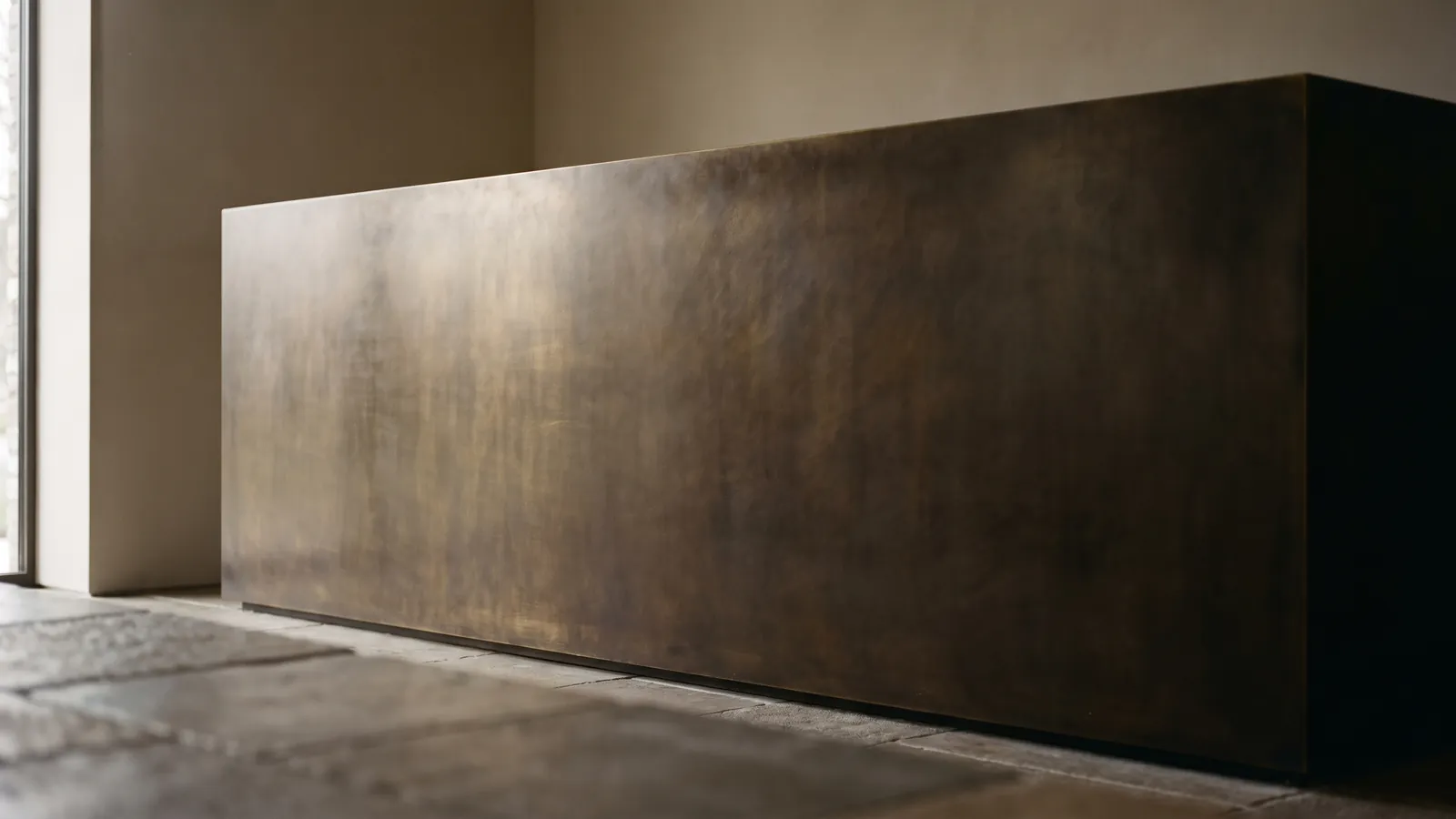
Blackened brass and bronze
Blackened brass and bronze is one of the warmest of the dark finishes, and one of the least understood. It carries the depth of a near-black metal while the warmth of the brass or bronze still reads through it. For an architect or designer specifying ironmongery, a reveal or a feature panel, the question is rarely whether it is black, but which black, how the warmth carries, and how it wears where hands fall. This guide sets out the finish and how it behaves, from the metalwork side of the table.
What blackened brass and bronze is
Blackened brass and bronze is real brass or bronze that has been chemically darkened rather than painted. The colour is a controlled oxide grown on the surface of the metal itself, so it sits in the metal rather than on top of it. That is the defining difference. A coat of paint hides the material, while a blackened finish darkens it and leaves the grain, warmth and working marks legible.
It is a close cousin of blackened steel, the same idea carried onto a warm alloy rather than mild steel, and a deeper relative of copper and bronze patina. A patina warms and colours the metal towards brown, green or a soft antique tone. Blackening takes it further and darker, to a brown-black or near-black, while the brass or bronze underneath still shows in the highlights. Where a patina settles a surface, blackening quietens it.

The tone range
Blackened brass and bronze is never a single flat black. The base tone runs from a warm brown-black through gunmetal to a deep, near-black, and the metal underneath sets how warm it reads. Brass blackens to a warmer, more golden-shadowed dark. Bronze goes deeper and browner, closer to a settled antique. Light falls into the oxide the way it does in a patina, so a single panel reads brown-black in shadow and warmer where it catches the light. The warmth is the point. A blackened surface keeps the life of the metal inside the dark, where a painted black would read flat.

How the finish is made
Blackening is a chemical process. The clean brass or bronze is treated with a blackening or oxidising solution that grows a dark oxide across the surface. The depth is controlled by the solution strength, the temperature and the time, and by how the metal is worked beforehand. A brushed surface blackens to a fine directional dark, a polished surface deeper and glossier, a textured surface catching the dark in its lows and the light on its highs.
The oxide is left bare and slightly porous, so it is not finished until it is sealed. The seal is where the character is set. A penetrating oil or wax gives a warm, hand-rubbed depth that can be renewed over time. A lacquer holds a more fixed, even tone. The seal is chosen against the room, the traffic and how the client wants the surface to age, the same considered sealing set out in caring for metal finishes.
Living or sealed: how it wears
This is the decision that matters most on a blackened brass or bronze specification, and it is worth settling early.
A sealed finish, held under a good lacquer or a renewed oil, stays close to the dark it was made at. It resists handling and keeps an even tone, which suits a surface that should read the same across a project.
A living finish is left to wear. At the high-touch points, an edge, a pull, the face of a handle, the dark rubs back and the warm brass or bronze shows through where hands fall. Many clients want exactly this. It asks for acceptance of change rather than maintenance, and can be re-blackened or re-oiled if a more even dark is wanted. Neither is right or wrong. They are two intentions, and the client should choose knowingly.

Where blackened brass and bronze works
Blackened brass and bronze earns its place where a dark metal should still feel warm.
On ironmongery, pulls and fittings, it gives the hand a dark, warm metal that wears honestly. On reveals, frames and trims it draws a fine, quiet dark line. As feature panels and joinery faces it gives a wall or a cabinet weight and depth without the flatness of paint. On bar and reception fronts it carries a dark, considered scheme. In dark, quiet interiors it holds the room together, warmer than blackened steel and deeper than a patina.
For the range of brass finishes from bright to antique, see brass finishes for architecture, and for bronze specifically, see architectural bronze.
Blackened brass vs black PVD on stainless
A dark stainless finish is often weighed against blackened brass or bronze, and the two are not the same thing.
Black PVD is a hard, fixed black bonded onto a stainless steel substrate. It is even, scratch and tarnish-resistant, and does not change with use, so it suits exterior, marine, high-touch and large surfaces where a constant black is wanted. It is covered in the PVD colour palette.
Blackened brass or bronze is a living, darkened surface on real metal. It carries a warmth and depth that a hard coating cannot, and is meant to be handled and to age. Where a project needs a perfectly uniform, unchanging black, black PVD on stainless is the better specification, a question of position, budget and whether the surface should age or stay constant.
Care and renewal
Care follows the seal. A lacquered blackened surface is wiped with a soft, dry or barely damp cloth, keeping abrasive pads and acidic or chlorine-based cleaners away from the lacquer. An oiled or waxed surface is dusted the same way and re-oiled as it asks for it, which also feeds minor scuffs back in by hand.
A living finish needs the least, and can be re-blackened and re-sealed if a more even dark is wanted again. The single most useful thing on a specification is to state, for each piece, whether it is sealed or living, so care and expectation match the finish.
Working with Dekap
If you are asking whether we make this finish, the answer is yes. Dekap blackens brass and bronze in-house, from a single piece of ironmongery to panelised feature faces. We seal, where wanted, with our own protective formula, developed in the atelier to hold the colour and resist wear longer than a standard seal, and work from approved sample plates so the tone is signed off before production and documented for contract-grade specification. Where a position needs a fixed, non-living black, we deliver the same dark read as a hard black PVD on stainless, or guide the specification there. The same hands carry the piece from drawing to the sealed, crated finish on its way to site.
If you are specifying a warm dark metal for a current project, start a project enquiry, and tell us the metal, the position and whether you want it sealed or living. We will recommend the finish, not just supply it.
FAQ
What is blackened brass and bronze?
Blackened brass and bronze is real brass or bronze that has been chemically darkened to grow a dark oxide on the surface of the metal, rather than painted. The colour sits in the metal, so the warmth and grain stay visible and the surface reads as a warm dark rather than a flat black.
How is blackened brass different from blackened steel?
They are the same idea on different metals. Blackened steel darkens mild steel to a charcoal or gunmetal grey. Blackened brass and bronze darkens a warm alloy, so the dark keeps a golden or brown warmth and the metal shows through at the wear points. Both are chemically darkened surfaces rather than paint.
How is it different from a patina?
A patina warms and colours brass or bronze towards brown, green or a soft antique tone. Blackening takes the same metal darker, to a brown-black or near-black, while the brass or bronze still reads through in the highlights. Blackening quietens a surface where a patina settles it.
Does the finish wear, and can you keep it even?
A sealed finish held under a lacquer or a renewed oil stays close to its dark, even tone. A living finish is left to wear, and the dark rubs back to warm brass or bronze at the high-touch points, which many clients want. If a more even dark is wanted again, the surface can be re-blackened and re-sealed.
Blackened brass or black PVD, which should I specify?
Use blackened brass or bronze where a warm, living dark on real metal is wanted and the surface can be handled and allowed to age. Use black PVD on stainless where you need a hard, fixed, scratch and tarnish-resistant black for exterior, marine, high-touch or large surfaces, or where the black must stay perfectly constant.
Does Dekap make blackened brass or bronze?
Yes. We blacken brass and bronze bespoke, from a single piece of ironmongery to panelised feature faces, blackened, sealed and finished in-house and signed off against a sample plate. We seal it, where wanted, with our own protective formula for longer-lasting colour and wear, and where a position needs a fixed, non-living black, we deliver it as a hard black PVD on stainless or guide the specification there.
Specifying a warm dark metal?
Tell us the metal, the position and whether you want it sealed or living. We will recommend the finish, not just supply it.
Start a project enquiry