Metalwork in restaurant and bar interiors
A restaurant is read before the first plate arrives. A guest takes in the light, the noise, the way a bar catches the eye across the room, and decides in a few seconds what kind of evening this will be. Metal does a good deal of that quiet work. The back bar that glows behind the bottles, the counter edge a hand rests on, the screen that turns a wide room into a set of smaller ones. This piece looks at how bespoke metalwork shapes a restaurant and a bar, and what to weigh when specifying it.
Metal in hospitality food and drink
Metal earns its place in a dining room because it carries light and holds up to use at the same time. A warm brushed plane behind a bar lifts the whole room after dark. A dark, grounded metal gives a counter weight and calm. A patinated surface lends a new fit-out the feel of a place that has been there for years. In hospitality the finish is not trim added at the end. It is part of how the room reads the moment a guest walks in, and part of how it survives a busy service.
Back bars and counters
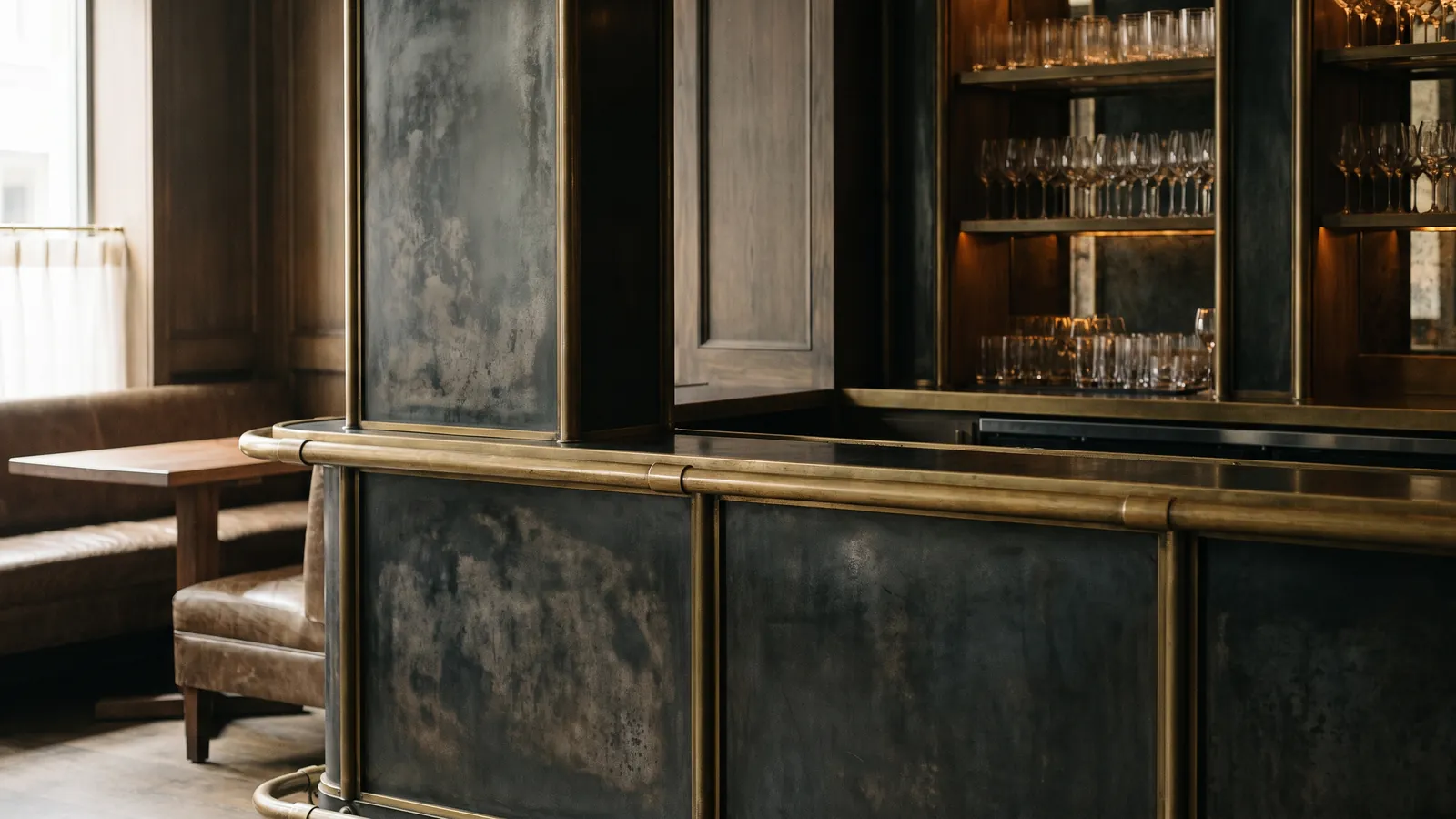
The back bar is the set piece, and metal is its natural language. A panelled fascia, a fluted front, a shelf run in warm brass or dark steel: this is the surface a room is built around, lit from within and seen from every seat. The bar counter is the other half of the pair, the edge that takes elbows, glasses, spills and a nightly wipe-down. Because the counter is touched constantly and the back bar is seen constantly, the two are often made as one family of metal in a single agreed finish, so the bright, hard-wearing surface falls where hands land and the feature surface sits where the eye does.
Our own view, from years of finishing these pieces: a back bar can carry a living or patinated finish because it is seen more than handled, but the working counter and the bar top want a hard, sealed surface that shrugs off citrus, spirits and a cloth. Mixing the two knowingly is what makes a bar look considered rather than fussy.

Screens and dividers
Metal screens and perforated panels do quiet spatial work in a restaurant. They break a long room into arrival, dining and bar without walling it off, hold sightlines away from a service pass, and soften the acoustic bounce that makes a hard room tiring. As dividers between booths or around a private table they give privacy that still reads as open. Perforation patterns, woven mesh and fluted panels each throw their own light and shadow through an evening, and each can be made bespoke to a scheme rather than pulled from a range.

Finishes for grease, heat and cleaning
A restaurant and bar is one of the more demanding interiors a finish will meet: airborne grease near the kitchen and behind the bar, heat at the pass, citrus and alcohol on the counter, and a hard clean every single night. The finish has to be chosen for the position, not just the look.
Coloured stainless by PVD carries warm and dark metal tones in a hard, sealed surface that resists scratches, tarnish and repeated cleaning, which is why it suits high-touch counters, bar fronts and large planes near food and drink. Blackened steel gives a grounded, hand-made depth for fascias, features and sheltered surfaces. Patinated bronze and brass bring warmth and age where a piece is meant to feel settled and is seen more than touched. The craft is matching each finish to where it sits, the tough sealed surfaces where grease and cloths fall, the living finishes where they are admired rather than scrubbed. We have seen a bright unsealed brass counter next to a busy service well go patchy within a season, which is exactly the position a sealed finish is made for.

Specifying bespoke
Three things make a hospitality commission run well. Time: bespoke metalwork is designed, engineered, made and finished, so it belongs in the programme early rather than late, especially where a bar has to be built and installed around services. Samples: finishes are agreed on approved sample plates before production, so the tone on site matches the intent. Detailing and installation: back bars, counters and screens are engineered for fixing, tolerance and delivery to a live site, often installed in sequence with the fit-out and around a tight opening date. A maker who carries a piece from design intent through to the finished, crated surface removes a layer of coordination from a project already short on time.
Restaurant and bar metalwork with Dekap
If you are asking whether we make this, the answer is yes. Dekap designs, engineers and makes bespoke restaurant and bar metalwork end to end: back bars, fascias and shelf runs, bar and service counters, screens, dividers and feature surfaces. We finish in-house across coloured PVD, blackened steel and patinated bronze and brass, and we seal high-use surfaces with our own protective formula, developed in the atelier to stand up to grease, heat and nightly cleaning better than a standard lacquer. Every finish is matched to an approved sample plate before production. This reflects how we finish and specify metal for hospitality interiors in our own workshop. Where a position is high-touch, near heat or a large plane, we guide the specification toward a hard PVD finish that holds its colour. We work to opening programmes, document finishes for contract-grade specification, and keep client and project detail in confidence. See the materials we work in for the metals behind each finish.
If you are shaping a restaurant or a bar, start a project enquiry, and tell us the pieces, the finishes and the opening date. We will recommend the approach, not just supply the metal.
FAQ
What metalwork is used in restaurants and bars?
Most often back bars, fascias and shelf runs, bar and service counters, and screens or dividers, along with smaller pieces such as rails, trims and fittings. In considered hospitality these are usually bespoke, made to the designer's drawing rather than bought as standard products, so the metal reads as one family across the room.
Which finishes handle grease and heat?
Hard, sealed finishes carry the load best where grease, heat and cleaning fall. Coloured stainless by PVD resists scratches, tarnish and repeated cleaning on counters, bar fronts and large surfaces near food and drink. Blackened steel and patinated bronze and brass suit fascias and features that are seen more than handled. Matching the finish to the position is the key decision.
Are metal finishes easy to clean in a restaurant?
Sealed finishes such as coloured PVD stainless are made for daily cleaning and wipe down easily without abrasive pads or harsh chemicals. Living finishes such as unlacquered brass or patina are meant to age and are better kept away from the busiest, greasiest positions. Stating for each piece whether it is sealed or living keeps care and expectation matched to the finish.
How long does bespoke bar metalwork take?
Because each piece is designed, engineered, made and finished, bespoke bar metalwork needs to be planned into the programme early rather than added late, especially where it is built around services and a fixed opening date. Lead time depends on the scale and complexity of the pieces and the finishing involved, and is agreed at the start of a commission.
How do you protect a bar counter against wear?
The working surfaces that take spirits, citrus and a nightly clean are best specified in a hard, sealed finish rather than a bare living one. A hard PVD colour on stainless resists scratches and tarnish, and a sealed metal front holds its look under constant contact. The back bar behind can carry a softer or living finish because it is seen more than touched.
Does Dekap make restaurant and bar metalwork?
Yes. We design, engineer and make bespoke restaurant and bar metalwork end to end, back bars, counters, screens and feature surfaces, finished in-house in coloured PVD, blackened steel and patinated bronze and brass. We seal high-use surfaces with our own protective formula for grease, heat and daily cleaning, match finishes to approved sample plates, work to opening programmes, and keep client and project detail in confidence.
Shaping a restaurant or a bar?
Tell us the pieces, the finishes and the opening date. We will recommend the approach, not just supply the metal.
Start a project enquiry