PVD Coating / Machines and consultancy
PVD investmentPVD coating machines and plant consultancy
PVD coating is not the only thing we offer. For companies ready to make the investment, we design, build, install and commission the system itself: arc and sputter PVD machines built in our own workshop, vacuum leak detection by helium, and plant consultancy from feasibility to training. All from a team that has both coated and built lines for years.
PVD coating machines: arc and sputter
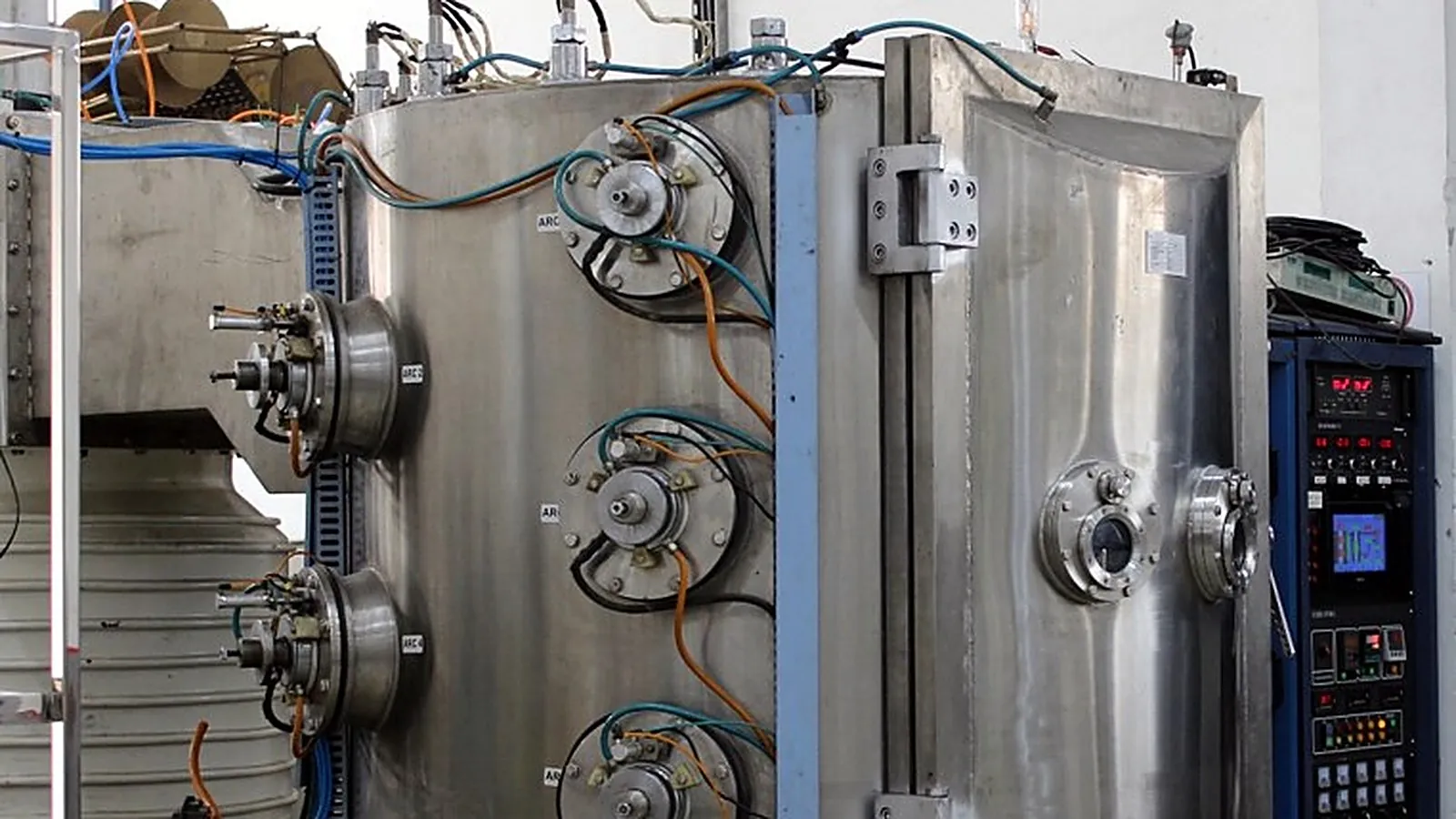
We design and build PVD coating systems in our own workshop and install them on site. We work with two core technologies. Cathodic arc gives high ionisation and fast deposition, and is strong for hard functional and decorative coatings. Magnetron sputter gives smoother, more uniform, controlled thin films, and is preferred for large surfaces and precision work.
We size the system to the type of part, the target coatings and the production volume. Most plants use arc and sputter together. We deliver more than the machine: installation, commissioning and operator training, so the line is handed over production-ready.

Vacuum leak detection with helium
A vacuum system only works if it is leak free. Even the smallest leak lowers vacuum quality, coating repeatability and energy efficiency. With a helium mass spectrometer (helium leak detector) we precisely find leaks in the vacuum chamber, flanges, seals, feed lines and feedthroughs.
We can carry out helium leak detection both on your existing line on site and in our workshop. We locate the leak points, report them and advise on the fix. We use the same method for commissioning a newly installed line and for the periodic check of a running line.

Plant consultancy
We advise companies that want to invest in PVD coating from start to finish. Before the investment decision we prepare a feasibility study: which coatings, which volume, which technology and what return. Once the decision is made we plan and carry out the plant setup: line layout, infrastructure and machine integration.
Process design follows: coating recipes, vacuum and temperature parameters, preparation and quality control flow. Finally we deliver operator and maintenance training, so your team runs the line correctly and on its own. In short, we do not just install the machine; we make it production-ready.
- Feasibility
- Plant setup
- Line layout
- Process and recipe design
- Quality control setup
- Operator training
- Maintenance training
Why Dekap
Most machine suppliers do not coat, and most coaters do not build machines. We have done both for years: we run PVD coating in our own workshop while we also build and install machines, carry out leak detection and give plant consultancy. That is why, when we design a line, we know what that line actually produces and where it will struggle.
We keep our references within client confidentiality, and we clarify the scope and fit of your project in a technical review. Tell us your part, your target coatings and your production volume, and we will set out the right technology, the feasibility and the investment roadmap.

Machine and consultancy FAQ
Do you sell PVD coating machines?
Dekap designs and builds arc and sputter PVD coating machines and installs them on site. Each machine is sized to your parts, target coatings and production volume, and installation, commissioning, coating recipes and operator training come with it. Because we run PVD every day in our own Istanbul atelier, on lines we build ourselves, the process advice comes from production rather than a catalogue.
What is the difference between arc and sputter PVD?
Cathodic arc PVD evaporates the target with an electric arc, giving high ionisation, dense films and fast deposition, which suits hard tool coatings and many decorative colours. Magnetron sputtering knocks atoms off the target with plasma ions, giving smoother, more uniform films with fewer droplets, preferred for large flat surfaces and precise colour. Many machines combine both sources in one chamber, and the mix is chosen for your parts.
What is helium leak detection and how is it done?
Helium leak detection finds leaks in a vacuum system by spraying helium around suspect points while a helium mass spectrometer watches the vacuum side for any trace of it. A PVD chamber only reaches and holds its process vacuum when it is leak free, so the test pinpoints leaks in the chamber, flanges, seals and feed lines before they cost coating quality or pumping time.
Do you carry out vacuum leak detection on an existing line on site?
Yes. We run leak detection on an existing PVD or vacuum line on site: we find the leak points, report them and advise on the fix. On request we also test parts or subsystems in the workshop.
What does plant consultancy cover?
Plant consultancy covers feasibility, plant setup, process design and training. Feasibility comes before the investment decision; then line layout and installation, the design of coating recipes and process parameters, and finally operator and maintenance training. The aim is a line that is ready for production, not only a machine that has been installed.
Do you share references?
Our PVD machine and plant references are kept under client confidentiality, so we do not publish names. Dekap has run PVD coating in its own Istanbul atelier since 2017, on lines it builds itself, alongside machine installation and leak detection work. In a technical meeting we walk you through comparable projects, process data and the approach we would take for your line.
How long does it take to build and install a PVD coating machine?
Designing and building a PVD coating machine takes six months to a year, depending on the chamber, the number and type of sources and the level of automation. Once the machine is delivered and the site utilities are ready, installation and commissioning take two to four weeks, followed by coating recipe set-up and operator training. The whole schedule is planned at feasibility stage.
What infrastructure does a PVD coating plant need?
A PVD coating plant needs a stable electrical supply, a cooling water circuit, compressed air, process gases such as argon and nitrogen, and clean floor space for the machine and its service access. Parts also need a cleaning and drying line before coating, because preparation decides adhesion. Dekap sets out the layout and utility list at feasibility stage, so the site is ready when the machine arrives.
Machine and plant enquiry
Planning a PVD line, or expanding an existing one? Tell us the parts, the target coatings and where you are in the investment. This goes to our engineering team, not the architecture studio. The more you can tell us, the sharper our feasibility answer.
During busy production periods we cannot always answer every call right away. If you cannot reach us, email or use the form and we will come back to you as soon as we can.
Ferhatpaşa Mahallesi, 16. Sokak, No:1/A, Ataşehir, İstanbul, Türkiye
PVD coating since 2017; machine installation and leak detection under one roof.