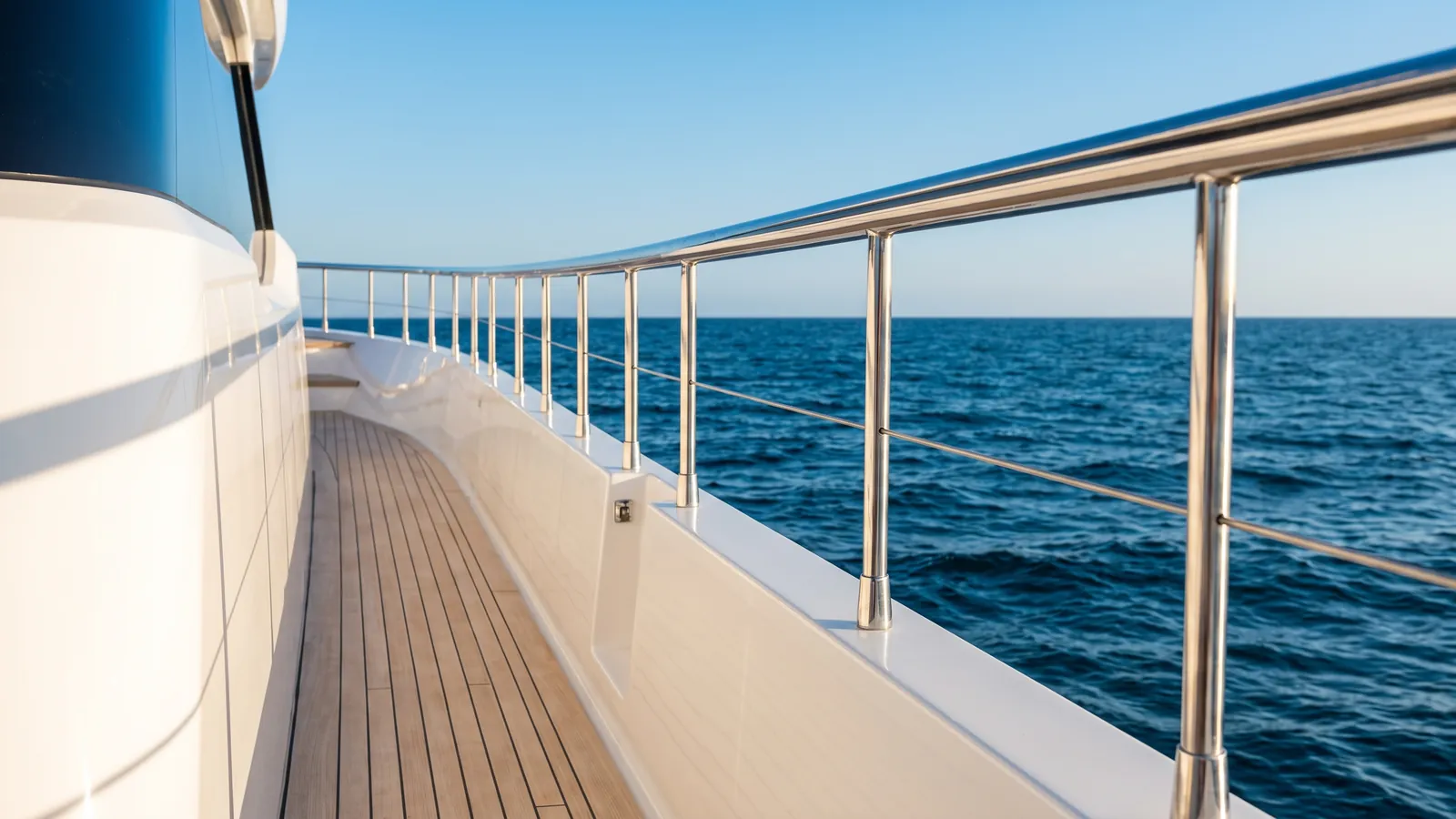
Metal in superyacht interiors
A superyacht interior asks metal to do two things at once: to look considered in a calm, expensive room, and to survive a salt-laden environment that punishes any surface left unprotected. The sea is patient and corrosive. Warm, humid air carries chloride into every joint and fixing, condensation gathers where you cannot see it, and hands, sun cream and cleaning products work at a finish every day. This piece looks at how metal performs on board, which materials and finishes hold up, and what matters when the work is made to a yard's programme.
Why metal on board
Metal earns its place in a yacht interior for the same reasons it does ashore, with weight added to the argument. It carries light across a balustrade, a bar front or a stair, and it grounds a room with a density no other material quite matches. But weight is also a constraint at sea, so the choice is rarely solid metal everywhere. Thin marine grade sheet over a stable core, careful section sizing and honest engineering keep the read of metal without the mass. Metal also takes daily contact better than most surfaces when it is specified and finished correctly, which is why it gathers at the points a guest touches: handrails, passerelle fittings, joinery edges, the hardware that is used a hundred times a day.
Marine grade materials
The substrate decision is the one that governs everything after it, and at sea it is not a place to economise. Standard stainless is not enough in a marine setting. The working choice is 316, and better still 316L, the low-carbon austenitic stainless with added molybdenum that resists chloride pitting far better than the 304 used ashore. On exterior-adjacent trims, wet areas and anything near the passerelle or the transom, 316L is the substrate we would specify and argue for.
Brass and bronze belong on board too, and behave differently from stainless. Bronze, the copper-tin alloy, has a long marine history and takes a patina that reads as warmth and age rather than damage. Brass gives the golden tone many interiors want. Both are handsome, both are workable, and both will react with a salt atmosphere if left bare, which moves the real question on to the finish. The honest position is that no metal is immune at sea. The substrate sets the baseline, the finish and the sealing carry the rest.

Finishes that survive the marine environment
A marine finish is judged on how it holds up where salt, sun and handling meet, not on how it looks on the sample plate alone. Several routes carry that load well. Coloured stainless by PVD is a hard, thin, vacuum-deposited colour bonded to a 316 substrate, resistant to scratches, tarnish and salt, which makes it a strong choice for high-touch fronts and larger planes that must stay constant. A DLC coating adds a very hard, low-friction dark layer where wear resistance is the priority, on hardware and surfaces that take constant contact. Coloured stainless steel covers how these tones are achieved and how they behave. Blackened steel and patinated bronze give grounded, living depth for sheltered interior features that are seen more than handled and kept away from the wettest positions. The discipline is matching the finish to the position: the hard, sealed surfaces where salt and hands fall, the living finishes inland of the weather.
One observation from the bench. We take a finish, seal it, and put it through salt and repeated handling before we trust it near a wet zone. A colour that looks perfect dry can lift at an edge once chloride finds a weak seal, and the edges and fixing points are always where it starts. That is why we treat the edge detail and the seal as seriously as the face of the metal.

Where metal works
On board, metal gathers at the points that are touched, climbed and leaned on. Stairs and their balustrades are the set piece, engineered to move with the vessel and to resolve from the sweep of the run down to a single baluster joint. Handrails are the metal a guest returns to, so they are finished for the hand and sealed for the salt. Joinery edges, inlays and reveals give a fine metal line through cabinetry. Bar and galley fronts take contact, spill and cleaning, which is where the harder coloured finishes earn their keep. And the passerelle, part fitting and part first impression, sits in the wettest, most exposed position of all, where 316L and a proven finish are not a luxury but the baseline.
Working with yards and design studios
Metalwork on a yacht is made into someone else's programme, and that changes how it is engineered. Tolerances are tighter and less forgiving than a building, because a bulkhead is not a plumb wall and everything has to fit a hull that curves. Access is planned around a build or a refit sequence, so pieces are dimensioned to pass through the openings that exist at the moment they are installed. Lead time has to sit inside the yard's critical path, which means finishes are agreed on approved sample plates early, not resolved late. On a refit the constraints are tighter again, matching new metal to what is already aboard and working in windows measured against a launch date. A maker who carries the piece from drawing through finishing to the crated, protected delivery removes a layer of coordination the yard would otherwise carry.
Metal in superyacht interiors with Dekap
If you are asking whether we make this, the answer is yes. This reflects how we specify and finish metal for marine interiors in our own workshop. Dekap designs, engineers and makes bespoke yacht interior metalwork end to end: stairs and balustrades, handrails, joinery metal, bar and galley fronts, passerelle and deck-adjacent fittings. We specify 316 and 316L for marine positions, finish in-house across coloured PVD, DLC, blackened steel and patina, and seal high-wear surfaces with our own protective formula, developed in the atelier to hold colour and resist salt and handling longer than a standard lacquer. Documented performance for the PVD route is set out on the PVD coating page. We work to yard and refit programmes, engineer to marine tolerances, match every finish to an approved sample plate before production, and keep client, yard and project detail in confidence.
If you are specifying metal for a yacht interior or a refit, start a project enquiry, and tell us the positions, the finishes and the yard programme. We will recommend the substrate and the finish, not just supply the metal.
FAQ
What metals suit yacht interiors?
Marine grade 316 and 316L stainless are the working choice, since the added molybdenum resists chloride pitting far better than standard stainless. Bronze and brass are also used for warmth and a living, patinated look. No metal is immune to a salt atmosphere when left bare, so the substrate and the protective finish are chosen together rather than separately.
Which finishes resist salt and corrosion?
Hard, sealed finishes carry the marine load best. Coloured stainless by PVD gives a scratch and tarnish-resistant surface on a 316 substrate, and a DLC coating adds a very hard, low-friction layer for high-wear hardware. Blackened steel and patina suit sheltered interior features kept away from the wettest positions. Matching the finish to the position, and sealing the edges, is the key decision.
Is PVD suitable for marine use?
Yes. PVD is a hard, thin colour bonded to a stainless substrate in a vacuum, which resists scratches, tarnish and salt better than a plated or lacquered finish, and it holds its colour rather than ageing. On a 316 or 316L base it is well suited to high-touch and exposed interior positions. Documented performance for the finish is set out on the PVD coating page.
Can you coat 316 stainless for yachts?
Yes. 316 and 316L are the substrates we prefer for marine work, and both take coloured PVD and DLC finishes well. The stainless provides the corrosion resistance and the coating provides the colour, the hardness and the wear resistance, with the edges and fixing points sealed and tested since that is where salt begins to work.
How do you work with a yard or refit schedule?
Metalwork is engineered to marine tolerances and dimensioned to pass through the access that exists at the point of installation. Finishes are agreed on approved sample plates early so they sit inside the yard's critical path, and on a refit the work is matched to existing metal and made in windows measured against a launch date. Pieces are delivered crated and protected, ready to install in sequence.
Does Dekap make yacht interior metalwork?
Yes. We design, engineer and make bespoke yacht interior metalwork end to end, from stairs, balustrades and handrails to joinery metal, bar fronts and passerelle fittings, specifying 316 and 316L for marine positions. We finish in-house in coloured PVD, DLC, blackened steel and patina, seal high-wear surfaces with our own protective formula, work to yard and refit programmes, and keep client, yard and project detail in confidence.
Specifying metal for a yacht interior?
Tell us the positions, the finishes and the yard programme. We will recommend the substrate and the finish, not just supply the metal.
Start a project enquiry